Phasors for Capacitors definitions Flashcards

Phasors for Capacitors definitions
Control buttons has been changed to "navigation" mode.
1/15
  • Phasor
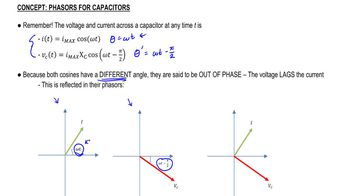
    A rotating vector used to represent sinusoidal functions in AC circuits, showing magnitude and phase angle.
  • Capacitor
    An electrical component that stores energy in an electric field, causing voltage to lag current in AC circuits.
  • AC Circuit
    An electrical circuit powered by alternating current, where voltage and current periodically reverse direction.
  • Voltage
    The electric potential difference across a component, lagging behind current in a capacitor by 90 degrees.
  • Current
    The flow of electric charge, leading the voltage by 90 degrees in a capacitor within an AC circuit.
  • Phase Angle
    The angular difference between the voltage and current waveforms in an AC circuit, 90 degrees for capacitors.
  • Omega
    The angular frequency of an AC waveform, determining the rate of rotation of phasors.
  • Cosine Function
    A trigonometric function used to describe the voltage and current waveforms in AC circuits.
  • Horizontal Axis
    The reference line in a phasor diagram representing the real part of a phasor's projection.
  • Counterclockwise Rotation
    The direction of phasor rotation in diagrams, indicating increasing phase angle over time.
  • Projection
    The component of a phasor on the horizontal axis, representing the instantaneous value of voltage or current.
  • Magnitude
    The length of a phasor, representing the amplitude of the voltage or current waveform.
  • Positive Voltage
    A condition where the voltage phasor points to the right, indicating an increasing magnitude.
  • Phase Difference
    The angular separation between voltage and current phasors, 90 degrees for capacitors.
  • Pi over 2
    The phase shift in radians between voltage and current in a capacitor, equivalent to 90 degrees.