In a pure capacitive AC circuit, by how many degrees are the current and voltage out of phase, and which one leads?
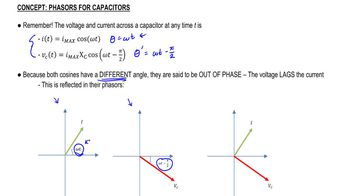
In a pure capacitive AC circuit, the current leads the voltage by 90 degrees, meaning the voltage lags the current by 90 degrees.
What is the mathematical expression for the angle of the current phasor in a capacitor in an AC circuit?
The angle of the current phasor is omega t. This means the current is described by a cosine function with angle omega t.
How is the angle for the voltage phasor across a capacitor expressed in terms of omega t?
The angle for the voltage phasor is omega t minus pi over 2. This shows the voltage lags the current by 90 degrees.
In a phasor diagram for a capacitor, how should the voltage and current phasors be positioned relative to each other?
The voltage phasor should lag 90 degrees behind the current phasor. This means the current phasor is always ahead of the voltage phasor in the diagram.
What does it mean for a phasor to be increasing in magnitude as it rotates in the diagram?
It means the phasor is moving closer to the horizontal axis, increasing its projection onto that axis. The value of the phasor increases as more of it points horizontally.
If the voltage across a capacitor is positive and increasing, in which direction does the voltage phasor point?
The voltage phasor points to the right. This indicates a positive and increasing voltage as it approaches the horizontal axis.
When drawing phasors for a capacitor, in which direction do the phasors rotate?
The phasors rotate counterclockwise. This is the standard convention for phasor diagrams in AC circuits.
What happens to the value of a phasor as it moves away from the horizontal axis in the diagram?
The value of the phasor decreases as it moves away from the horizontal axis. This is because its projection onto the axis becomes smaller.
At what position is the value of the voltage phasor at its maximum in the diagram?
The value is at its maximum when the phasor is exactly on the horizontal axis. This corresponds to the peak voltage across the capacitor.
How does the phase relationship between voltage and current in a capacitor differ from that in a resistor?
In a capacitor, voltage lags current by 90 degrees, while in a resistor, voltage and current are in phase. This difference is due to the distinct ways capacitors and resistors respond to AC signals.