Phasors definitions Flashcards
You can tap to flip the card.
Control buttons has been changed to "navigation" mode.
1/15
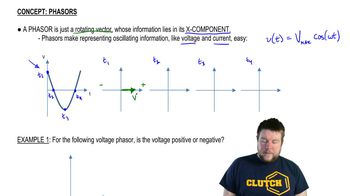
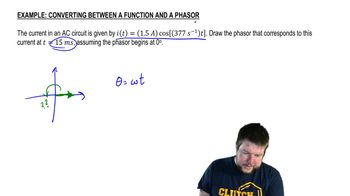
PhasorsRotating vectors used to simplify AC circuit analysis by representing oscillating values like voltage and current.X ComponentThe horizontal part of a phasor that contains all relevant information about the oscillating value.Vertical ComponentThe part of a phasor that can be ignored as it does not contain relevant information.Counterclockwise RotationThe direction in which phasors rotate, used to determine their position over time.Maximum VoltageOccurs when the phasor points entirely along the x-axis, indicating the largest value.Zero VoltageOccurs when the phasor has no x component and lies entirely along the vertical axis.Phasor DiagramsVisual representations of phasors at specific times, showing their position and direction.Angular FrequencyThe rate at which a phasor rotates, matching the frequency of the oscillations it represents.Magnitude CalculationFinding the size of a phasor using the Pythagorean theorem, similar to vector magnitude.Net PhasorThe resulting phasor from combining individual phasors, indicating the overall direction and value.Positive ValueIndicated when a phasor or net phasor points to the right along the x-axis.Negative ValueIndicated when a phasor or net phasor points to the left along the x-axis.ProjectionThe representation of a phasor's x component, determining its positive or negative value.Vector AdditionThe process of combining phasors by treating them like vectors to find a net result.OscillationThe repetitive variation, typically in time, of a value like voltage or current in AC circuits.