Phasors quiz #1 Flashcards

Phasors quiz #1
Control buttons has been changed to "navigation" mode.
1/10
  • How do you draw a phasor diagram to show the relationship between three voltage phasors, v1, v2, and v3, and how do you determine the net phasor?
    To draw a phasor diagram for three voltage phasors v1, v2, and v3, represent each phasor as an arrow (vector) originating from a common point. The direction and length of each arrow correspond to the phase and magnitude of each voltage. To find the net phasor, add the vectors head-to-tail: combine v1 and v3 if they are along the same axis (subtracting if they are in opposite directions), then add v2 if it is perpendicular. The resulting net phasor is the vector sum of v1, v2, and v3, and its direction and length represent the total voltage's phase and magnitude. The x-component of the net phasor determines whether the resulting voltage is positive (points right) or negative (points left).
  • What does the vertical component of a phasor represent in AC circuit analysis?
    The vertical component of a phasor does not represent any relevant information in AC circuit analysis. Only the x component is meaningful for voltage or current values.
  • At what position does a phasor point when the voltage is at its maximum positive value?
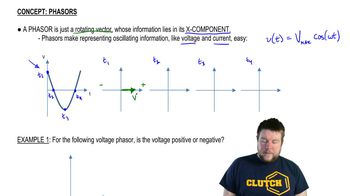
    The phasor points entirely to the right along the x-axis at maximum positive voltage. This orientation means its x component is at its largest positive value.
  • How does the direction of phasor rotation relate to the convention used in AC analysis?
    Phasors are conventionally considered to rotate counterclockwise in AC analysis. This rotation matches the progression of phase in oscillating signals.
  • What happens to the phasor's orientation when the voltage is zero during its oscillation?
    When the voltage is zero, the phasor lies entirely along the vertical axis. Its x component is zero at these points.
  • How is the angular frequency of a phasor's rotation related to the oscillation it represents?
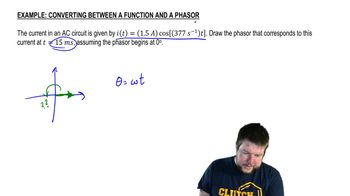
    The phasor rotates at the same angular frequency, omega, as the oscillation it represents. For example, if omega is 2 per second, the phasor completes two full rotations every second.
  • Why are phasors considered useful tools for analyzing AC circuits?
    Phasors are useful because they allow oscillating quantities like voltage and current to be represented as rotating vectors. This makes it easier to add, subtract, and analyze these quantities using vector methods.
  • What determines whether the value described by a phasor is positive or negative?
    The sign is determined by the direction of the phasor's x component. If it points right, the value is positive; if it points left, the value is negative.
  • How can you find the magnitude of a phasor when combining multiple phasors?
    You can use the Pythagorean theorem to find the magnitude of the net phasor, just as you would for vectors. This involves calculating the square root of the sum of the squares of the components.
  • What is the effect of freezing time on the analysis of phasors in a circuit?
    Freezing time allows you to treat phasors as static vectors at a particular instant. This enables straightforward vector addition and subtraction for circuit analysis.