How do you calculate the operating resistance of a light bulb given its power rating and the voltage it is designed for?
The operating resistance R of a light bulb can be calculated using the formula R = V^2 / P, where V is the operating voltage and P is the power rating.
How do you determine the rate at which electrical energy is dissipated in a resistor of known resistance and current?
The rate at which electrical energy is dissipated in a resistor (the power) is given by P = I^2 R, where I is the current through the resistor and R is its resistance.
If two resistors are connected in a circuit, how can you determine which resistor dissipates more power?
To determine which resistor dissipates more power, compare their power dissipation using P = I^2 R (if the current through each is known) or P = V^2 / R (if the voltage across each is known). The resistor with the higher calculated power dissipates more energy.
How do you calculate the total current in a circuit containing ten identical light bulbs, each rated at 60 watts, connected to a 120-volt supply?
First, find the total power: P_total = 10 × 60 W = 600 W. Then, use I = P_total / V, so I = 600 W / 120 V = 5 A.
In the context of electric circuits, what is the term for the amount of work being done per unit of time?
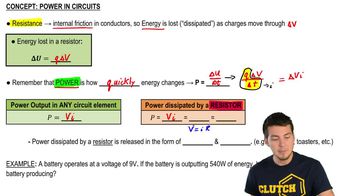
In electric circuits, the amount of work being done per unit of time is called power.
What is the physical meaning of resistance in a conductor as described in the context of circuits?
Resistance represents the internal friction that charges experience as they move through a conductor. This friction causes the charges to lose energy, typically in the form of heat.
How is the formula P = VI derived from the definitions of energy and current in a circuit?
P = VI is derived by substituting the energy lost by charges (ΔU = QΔV) into the power formula (P = ΔU/Δt) and recognizing that Q/Δt is the current I. This leads to P = ΔV × I, which simplifies to P = VI.
Why are there three different power formulas (P = VI, P = I^2R, P = V^2/R) for resistors, and when should each be used?
The three formulas are mathematically equivalent and are chosen based on which variables (V, I, or R) are known in a problem. You select the formula that allows you to solve for the unknown using the given information.
What happens to the electrical energy dissipated by a resistor in a circuit?
The electrical energy dissipated by a resistor is released as heat, and in some cases, also as light. This is why devices like toasters and light bulbs get hot or emit light when operating.
How do you calculate the total energy released by a resistor over a specific time interval if you know the power dissipated?
Multiply the power dissipated by the resistor by the time interval to find the total energy released. The formula is ΔU = P × Δt, where ΔU is energy, P is power, and Δt is the time.
How does the voltage of a power line affect the power delivered in an electrical circuit?
The voltage of a power line affects the power delivered in a circuit because power (P) is equal to the product of voltage (V) and current (I), as given by the formula P = VI. Increasing the voltage, for a given current, increases the power delivered. Additionally, in resistive circuits, power can also be expressed as P = V^2/R, showing that higher voltage increases power dissipation in the resistor for a fixed resistance.
 Back
Back
 06:18
06:18