Equilibrium with Multiple Objects definitions Flashcards

Equilibrium with Multiple Objects definitions
Control buttons has been changed to "navigation" mode.
1/15
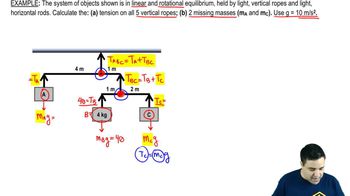
  • Rotational Equilibrium
    A state where the sum of all torques acting on a system is zero, resulting in no rotational motion.
  • Torque
    A measure of the force causing an object to rotate, calculated as force times distance from the pivot point.
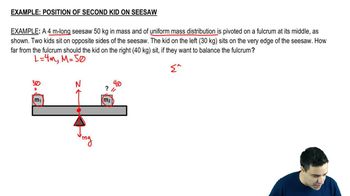
  • Fulcrum
    The pivot point around which a lever or seesaw rotates.
  • Uniform Mass Distribution
    A condition where mass is evenly distributed across an object, affecting its balance and center of gravity.
  • Axis of Rotation
    The line around which an object rotates, where forces acting on it do not produce torque.
  • Normal Force
    The force exerted by a surface perpendicular to an object resting on it, often counteracting gravity.
  • Seesaw
    A lever system with a fulcrum in the middle, used to demonstrate principles of balance and torque.
  • Mass
    A measure of the amount of matter in an object, influencing the gravitational force it exerts.
  • Distance
    The length between two points, crucial in calculating torque as it affects leverage.
  • Gravity
    The force that attracts a body toward the center of the earth, affecting weight and balance.
  • Balance
    A state where opposing forces or influences are equal, resulting in stability.
  • Pivot
    A fixed point supporting something that turns or balances, synonymous with fulcrum.
  • Lever
    A rigid bar resting on a pivot, used to help move a heavy or firmly fixed load with one end when pressure is applied to the other.
  • Center of Gravity
    The point in a body or system where the weight is evenly distributed or balanced.
  • Force
    An influence that can change the motion of an object, crucial in calculating torque.