Equilibrium with Multiple Objects quiz #1 Flashcards

Equilibrium with Multiple Objects quiz #1
Control buttons has been changed to "navigation" mode.
1/10
  • What condition must be satisfied for a system to be in rotational equilibrium?
    For rotational equilibrium, the sum of all torques acting on the system must be zero. This means that the clockwise and counterclockwise torques must balance each other.
  • In a seesaw with two children of different masses sitting at different distances from the fulcrum, how can you determine the position where the system will be in equilibrium?
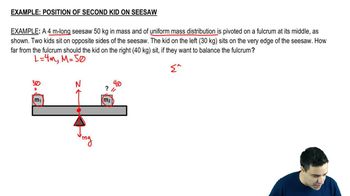
    To achieve equilibrium on a seesaw, the torques produced by each child about the fulcrum must be equal and opposite. This is expressed by the equation m1r1 = m2r2, where m1 and m2 are the masses of the children and r1 and r2 are their respective distances from the fulcrum.
  • Where is the center of mass located on a uniform seesaw?
    The center of mass of a uniform seesaw is located at its midpoint. This is also where the gravitational force of the seesaw acts downward.
  • Why do the gravitational force of the seesaw and the normal force at the fulcrum not produce torque in this problem?
    Both forces act at the axis of rotation, which is the fulcrum. Forces applied at the axis of rotation have zero lever arm and thus produce no torque.
  • What is the angle between the gravitational force and the position vector for each child on the seesaw?
    The angle between the gravitational force and the position vector for each child is 90 degrees. This means the sine of the angle is 1, simplifying the torque calculation.
  • If the seesaw is 4 meters long and pivoted at the center, what is the distance from the fulcrum to either end?
    The distance from the fulcrum to either end is half the total length, which is 2 meters. This is because the fulcrum is at the midpoint.
  • How does the torque equation simplify when the angle between the force and lever arm is 90 degrees?
    The sine of 90 degrees is 1, so the torque equation simplifies to just the product of force and distance. This makes the calculation straightforward.
  • What happens to the seesaw if both children sit at equal distances from the fulcrum but have different masses?
    The seesaw will tilt toward the heavier child. This is because the heavier child produces a greater torque at the same distance.
  • How can you express the required distance for the heavier child to achieve equilibrium using only variables?
    The required distance for the heavier child is r2 = (m1/m2) * r1. This formula ensures the torques are balanced for equilibrium.
  • Why is it important to identify which forces act at the axis of rotation in rotational equilibrium problems?
    Forces acting at the axis of rotation do not contribute to the net torque. Recognizing this simplifies the analysis by allowing you to ignore those forces in torque calculations.