Intro to Relative Velocity quiz #1 Flashcards

Intro to Relative Velocity quiz #1
Control buttons has been changed to "navigation" mode.
1/10
  • When two cars pass each other, how can you determine if they are traveling in the same direction using the concept of relative velocity?
    To determine if two cars are traveling in the same direction when they pass each other, compare their velocities relative to a common reference frame (such as the ground). If both velocities have the same sign (direction), the cars are moving in the same direction. If the velocities have opposite signs, they are moving in opposite directions. Passing can occur in either case, but if their velocities are both positive or both negative relative to the ground, they are traveling in the same direction.
  • What is the frame of reference typically used when measuring the velocity of cars on a road?
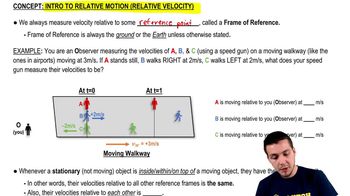
    The frame of reference is usually the ground or the earth. This means velocities are measured relative to the ground unless otherwise specified.
  • How does the velocity of a stationary person on a moving walkway compare to the walkway's velocity?
    The stationary person has the same velocity as the moving walkway. This is because they are being carried along at the same speed as the walkway.
  • If a person walks forward on a moving walkway, how do you calculate their velocity relative to the ground?
    You add the person's walking speed to the walkway's speed. The total is their velocity relative to the ground.
  • What happens to the measured velocity if a person walks in the opposite direction of a moving walkway?
    You subtract the person's walking speed from the walkway's speed. The result is their velocity relative to the ground.
  • What does it mean if two objects have the same velocity relative to a reference frame?
    It means their relative velocity to each other is zero. They move together as seen from that reference frame.
  • What is the general rule for flipping the order of subscripts in relative velocity notation?
    Flipping the subscripts reverses the sign of the velocity. For example, v_ab = -v_ba.
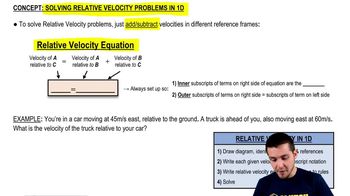
  • When setting up the relative velocity equation, what must be true about the inner subscripts on the right side?
    The inner subscripts on the right side must be the same. This ensures the equation is set up correctly.
  • In the equation v_ac = v_ab + v_bc, what do the outer subscripts on the right side represent?
    The outer subscripts on the right side match the subscripts of the term on the left side. This helps identify the correct variables to use.
  • If you are given v_cg but need v_gc, how do you obtain the correct value?
    You reverse the subscripts and change the sign of the velocity. For example, v_gc = -v_cg.