Pearson+ LogoPearson+ Logo

Resistors in AC Circuits quiz #1 Flashcards

Back
Resistors in AC Circuits quiz #1
Control buttons has been changed to "navigation" mode.
1/10
  • In AC circuits, what type of load contains pure resistance?

    A load that consists only of resistors contains pure resistance in AC circuits.
  • What is the shape of the current waveform produced by an AC source in a resistor circuit?

    The current waveform is always sinusoidal in an AC resistor circuit. This means it varies smoothly and periodically over time.
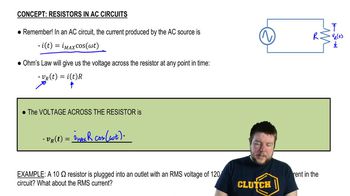
  • How is the voltage across a resistor in an AC circuit expressed as a function of time?

    The voltage across the resistor is given by the current as a function of time multiplied by the resistance. Mathematically, it is v(t) = i(t) × R.
  • What is the formula for the maximum current in a resistor connected to an AC source?

    The maximum current is the square root of 2 times the RMS current. This can be written as I_max = √2 × I_RMS.
  • How do you calculate the RMS current for a resistor in an AC circuit?

    The RMS current is found by dividing the RMS voltage by the resistance. The formula is I_RMS = V_RMS / R.
  • If a 10 ohm resistor is connected to a 120 V RMS AC source, what is the RMS current?

    The RMS current is 120 V divided by 10 ohms, which equals 12 amps. This uses the formula I_RMS = V_RMS / R.
  • How do you find the maximum current from the RMS current in an AC resistor circuit?

    Multiply the RMS current by the square root of 2 to get the maximum current. This relationship comes from the properties of sinusoidal waveforms.
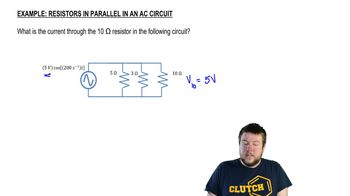
  • What is the equivalent resistance when multiple resistors are present in an AC circuit?

    The equivalent resistance is found by combining the resistors just as in DC circuits. You then use this equivalent resistance in your calculations.
  • Can you use the same equations for resistors in AC circuits as in DC circuits?

    Yes, the same equations apply for combining resistors and calculating currents and voltages. The main difference is that AC quantities may be expressed as RMS or maximum values.
  • Why are resistor problems in AC circuits considered simple compared to other AC circuit elements?

    Resistor problems are simple because the current and voltage remain in phase and calculations use basic Ohm's Law. There are no phase shifts or reactive components to consider.