Skip to main content
Physics with Calculus
My Course
Learn
Exam Prep
AI Tutor
Study Guides
Textbook Solutions
Flashcards
Explore
Try the app
My Course
Learn
Exam Prep
AI Tutor
Study Guides
Textbook Solutions
Flashcards
Explore
Try the app
Back
Resistors and Ohm's Law definitions
You can tap to flip the card.
Ohm's Law
You can tap to flip the card.
👆
Ohm's Law
A fundamental equation in physics, expressed as V = IR, relating voltage, current, and resistance.
Track progress
Control buttons has been changed to "navigation" mode.
1/15
Related flashcards
Related practice
Recommended videos
Resistors and Ohm's Law quiz
Resistors and Ohm's Law
10 Terms
Resistors and Ohm's Law quiz #1
Resistors and Ohm's Law
39 Terms
Resistors and Ohm's Law quiz #2
Resistors and Ohm's Law
13 Terms
Resistors and Ohm's Law
27. Resistors & DC Circuits
7 problems
Topic
Patrick
Power in Circuits
27. Resistors & DC Circuits
7 problems
Topic
Patrick
27. Resistors & DC Circuits - Part 1 of 2
4 topics
12 problems
Chapter
Patrick
27. Resistors & DC Circuits - Part 2 of 2
5 topics
14 problems
Chapter
Patrick
Guided course
02:33
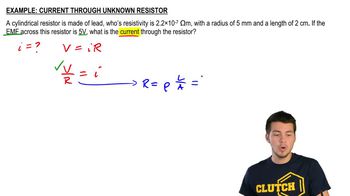
Current Through Unknown Resistor
9065
views
179
rank
Guided course
03:07
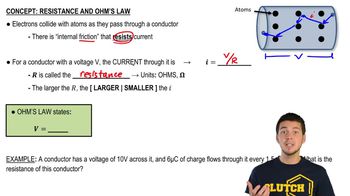
Resistance and Ohm's Law
14209
views
313
rank
1
comments
Guided course
05:25
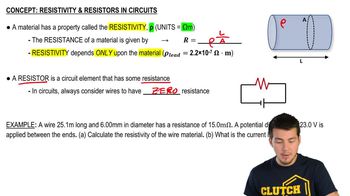
Resistivity & Resistors in Circuits
12104
views
263
rank
4
comments
Terms in this set (15)
Hide definitions
Ohm's Law
A fundamental equation in physics, expressed as V = IR, relating voltage, current, and resistance.
Resistance
The property of a conductor that opposes the flow of electric current, measured in ohms.
Voltage
The potential difference across a conductor, driving the flow of electric current.
Current
The flow of electric charge through a conductor, measured in amperes.
Resistivity
A material-specific property indicating how strongly a material opposes electric current, measured in ohm-meters.
Conductor
A material that allows the flow of electric charge, with resistance depending on its resistivity, length, and area.
Ohms
The unit of measurement for resistance, symbolized by the Greek letter omega (Ω).
Microcoulombs
A unit of electric charge equal to 10^-6 coulombs.
Amperes
The unit of measurement for electric current, often abbreviated as amps.
Resistor
A circuit element that provides resistance to the flow of electric current.
Circuit
A closed loop through which electric current flows, often including elements like resistors and capacitors.
Potential Difference
The difference in electric potential between two points, driving current through a circuit.
Cross-sectional Area
The area of a conductor's cross-section, affecting its resistance.
Length
The distance a conductor extends, influencing its resistance.
Zero Resistance
An assumption in circuit analysis that wires have negligible resistance.
 BackBack
 02:33
02:33