Skip to main content
Physics with Calculus
My Course
Learn
Exam Prep
AI Tutor
Study Guides
Textbook Solutions
Flashcards
Explore
Try the app
My Course
Learn
Exam Prep
AI Tutor
Study Guides
Textbook Solutions
Flashcards
Explore
Try the app
Back
Resistors and Ohm's Law quiz #2
You can tap to flip the card.
What provides resistance in a circuit?
You can tap to flip the card.
👆
What provides resistance in a circuit?
A resistor provides resistance in a circuit.
Track progress
Control buttons has been changed to "navigation" mode.
1/13
Related flashcards
Related practice
Recommended videos
Resistors and Ohm's Law definitions
Resistors and Ohm's Law
15 Terms
Resistors and Ohm's Law quiz
Resistors and Ohm's Law
10 Terms
Resistors and Ohm's Law quiz #1
Resistors and Ohm's Law
39 Terms
Resistors and Ohm's Law
27. Resistors & DC Circuits
7 problems
Topic
Patrick
Power in Circuits
27. Resistors & DC Circuits
7 problems
Topic
Patrick
27. Resistors & DC Circuits - Part 1 of 2
4 topics
12 problems
Chapter
Patrick
27. Resistors & DC Circuits - Part 2 of 2
5 topics
14 problems
Chapter
Patrick
Guided course
02:33
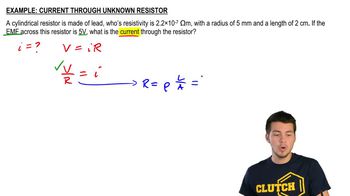
Current Through Unknown Resistor
9066
views
179
rank
Guided course
03:07
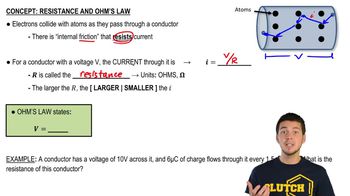
Resistance and Ohm's Law
14210
views
313
rank
1
comments
Guided course
05:25
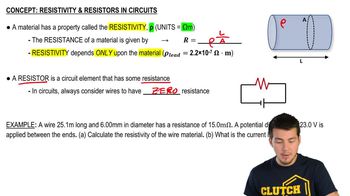
Resistivity & Resistors in Circuits
12105
views
263
rank
4
comments
Terms in this set (13)
Hide definitions
What provides resistance in a circuit?
A resistor provides resistance in a circuit.
What type of load contains pure resistance?
A resistive load contains pure resistance.
What is the opposition to current flow in a conductor called?
The opposition to current flow in a conductor is called resistance.
What is used to control electric current in a circuit?
A resistor is used to control electric current in a circuit.
Which symbol and unit of measurement are used for resistance?
Resistance is symbolized by R and measured in ohms (Ω).
Ohm's Law describes the relationship between which quantities?
Ohm's Law describes the relationship between voltage (V), current (I), and resistance (R).
Which unit is used to measure resistance?
The unit used to measure resistance is the ohm (Ω).
What is Ohm's Law?
Ohm's Law states that V = I × R, where V is voltage, I is current, and R is resistance.
What provides resistance in an electric circuit?
A resistor provides resistance in an electric circuit.
Describe an application that is not related to Ohm's Law.
Calculating capacitance or inductance in a circuit is not an application of Ohm's Law, which only relates voltage, current, and resistance.
Describe how resistance affects electric current.
Increasing resistance in a circuit decreases the electric current, according to Ohm's Law (I = V / R).
In a DC circuit, what opposes current flow?
In a DC circuit, resistance opposes current flow.
What units are used to measure resistance?
Resistance is measured in ohms (Ω).
 BackBack
 02:33
02:33