Resonance in Series LRC Circuits quiz #1 Flashcards

Resonance in Series LRC Circuits quiz #1
Control buttons has been changed to "navigation" mode.
1/10
  • What is an example of resonance in a series LRC circuit?
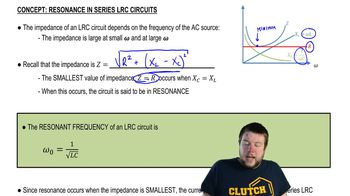
    Resonance in a series LRC circuit occurs when the frequency of the applied voltage causes the inductive reactance and capacitive reactance to be equal in magnitude. At this resonant frequency, the impedance of the circuit is minimized (equal to the resistance), resulting in the maximum possible current through the circuit.
  • How does the impedance of a series LRC circuit behave at very low and very high frequencies?
    At very low frequencies, the capacitive reactance becomes very large, increasing the impedance. At very high frequencies, the inductive reactance becomes very large, also increasing the impedance.
  • What is the mathematical expression for the impedance in a series LRC circuit?
    The impedance Z is given by the square root of R squared plus the square of the difference between XL and XC. Mathematically, Z = sqrt(R^2 + (XL - XC)^2).
  • What condition must be met for the impedance in a series LRC circuit to reach its minimum value?
    The impedance is minimized when the inductive reactance equals the capacitive reactance (XL = XC). At this point, the circuit is in resonance.
  • How is the resonant angular frequency (omega) of a series LRC circuit calculated?
    The resonant angular frequency is calculated as omega = 1 / sqrt(LC). This is derived by setting XL equal to XC and solving for omega.
  • What is the relationship between the maximum current and the impedance at resonance in a series LRC circuit?
    At resonance, the maximum current is equal to the maximum voltage divided by the resistance, since impedance equals resistance. This results in the largest possible current for the circuit.
  • In the provided example, what is the calculated resonant frequency for a circuit with a 2 H inductor and a 1.2 mF capacitor?
    The resonant frequency is calculated to be approximately 3.25 Hz. This is found by converting the angular frequency to linear frequency using f = omega / (2π).
  • What is the maximum current in the example circuit when a 120 V source is connected to a 10 ohm resistor at resonance?
    The maximum current is 12 amps. This is calculated by dividing 120 volts by 10 ohms.
  • Why is the current the same through all components in a series LRC circuit?
    In a series circuit, the same current flows through the resistor, inductor, and capacitor. This is a fundamental property of series circuits.
  • At resonance, what can be said about the maximum voltage across the inductor and the capacitor in a series LRC circuit?
    At resonance, the maximum voltage across the inductor is equal to the maximum voltage across the capacitor. This is because their reactances are equal at this frequency.