Control buttons has been changed to "navigation" mode.
1/10
Terms in this set (10)
When you are at the bottom of a loop on a roller coaster, what can be said about your gravitational potential energy compared to other points on the loop?
At the bottom of a loop on a roller coaster, your gravitational potential energy is at its lowest compared to other points on the loop, because gravitational potential energy depends on height and the bottom is the lowest point.
At what point on a roller coaster is the gravitational potential energy (GPE) the lowest?
The gravitational potential energy on a roller coaster is lowest at the lowest point of the track, such as the bottom of a loop, because GPE depends on height above the ground.
How does the gravitational potential energy of a roller coaster cart change as it moves from the top to the bottom of a loop?
As a roller coaster cart moves from the top to the bottom of a loop, its gravitational potential energy decreases because it is losing height, reaching its minimum value at the bottom of the loop.
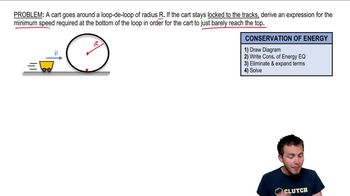
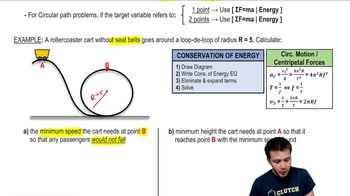
What physical condition at the top of the loop ensures passengers do not fall out of the roller coaster cart?
The normal force between the passengers and the seat must be zero at the top of the loop. This means gravity alone provides the required centripetal force.
Why can the mass of the roller coaster cart be canceled out when calculating the minimum speed at the top of the loop?
The mass appears in every term of the force equation once the normal force is set to zero. This allows it to be algebraically canceled, simplifying the calculation.
What is the relationship between the height of the loop and its radius in roller coaster problems?
The height of the loop is always twice the radius, so h = 2r. This is used to determine the potential energy at the top of the loop.
When setting up the energy conservation equation for the roller coaster, why is the initial kinetic energy at point A set to zero?
The problem asks for the minimum height, which assumes the cart starts from rest at point A. Therefore, the initial kinetic energy is zero.
What does it mean physically if the calculated speed at the top of the loop is less than the minimum required value?
If the speed is less than the minimum, the passengers would lose contact with their seats and begin to fall. This is because gravity would exceed the required centripetal force.
How do you determine which physics principle (forces or energy) to use in different parts of a roller coaster problem?
Use force analysis (f = ma) when the target variable refers to a single point, such as speed at the top of the loop. Use energy conservation when the variable involves a transition between two points, like finding the starting height.
Why is there no work done by non-conservative forces in the roller coaster problem described?
The problem states there is no friction and no external work done by the rider. Therefore, all energy changes are due to conservative forces only.