Pearson+ LogoPearson+ Logo

Root-Mean-Square Velocity of Gases quiz #1 Flashcards

Root-Mean-Square Velocity of Gases quiz #1
Control buttons has been changed to "navigation" mode.
1/10
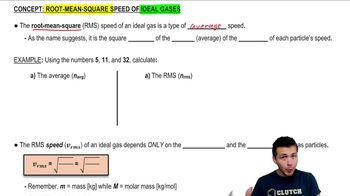
  • What is the formula for the root mean square (RMS) velocity of a nitrogen (N₂) molecule in an ideal gas, and what variables does it depend on?

    The root mean square (RMS) velocity of a nitrogen (N₂) molecule in an ideal gas is given by the formula: v_RMS = sqrt(3RT/M), where R is the gas constant, T is the temperature in Kelvin, and M is the molar mass of nitrogen in kilograms per mole. The RMS velocity depends on the temperature and the molar mass of the gas.
  • How does the root mean square (RMS) speed compare to the arithmetic mean speed for a set of values?

    The RMS speed is generally higher than the arithmetic mean because it is skewed toward larger values due to squaring. This makes the RMS more sensitive to higher speeds in the distribution.
  • What is the first step in calculating the RMS value for a set of numbers?

    The first step is to square each of the individual values in the set. This prepares the values for averaging before taking the square root.
  • Why must temperature be converted to Kelvin when using the RMS speed formula for gases?

    The RMS speed formula requires temperature in Kelvin because it is an absolute scale starting from absolute zero. Using Celsius would give incorrect results since it does not start at absolute zero.
  • What unit must the molar mass be in when using the VRMS = sqrt(3RT/M) formula?

    The molar mass must be in kilograms per mole for the formula to yield the correct units for speed. Using grams per mole would result in an incorrect calculation.
  • What is the value of the universal gas constant R used in the RMS speed calculation?

    The universal gas constant R is 8.314 J/(mol·K). This value is used in the VRMS formula when working with molar mass.
  • What happens to the RMS speed of gas particles as the temperature increases?

    The RMS speed increases as temperature increases because the particles have more kinetic energy. This relationship is due to the direct proportionality between temperature and the square of the speed.
  • Why is hydrogen gas not abundant in Earth's atmosphere according to the RMS speed concept?

    Hydrogen gas has a very high RMS speed at typical atmospheric temperatures, allowing its molecules to escape Earth's gravity more easily. This leads to a low abundance of hydrogen in the atmosphere.
  • What is the RMS speed of hydrogen gas at 27°C, and what does this imply about its motion?

    The RMS speed of hydrogen gas at 27°C is about 1934 meters per second. This high speed means hydrogen molecules move extremely fast in the atmosphere.
  • What is the difference between using the mass of a single particle and the molar mass in the RMS speed formula?

    Using the mass of a single particle involves Boltzmann's constant, while using molar mass involves the universal gas constant R. The choice depends on whether you are working with individual molecules or moles of gas.