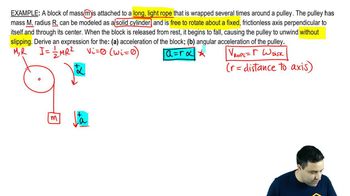
What happens when a rigid object rotates about a fixed axis in terms of its motion and the equations used to describe it?
When a rigid object rotates about a fixed axis, it undergoes rotational motion characterized by angular acceleration (alpha). The rotational version of Newton's second law applies: the sum of torques equals the moment of inertia times angular acceleration (ΣTorque = I·alpha). If the object also has linear motion, both ΣF = m·a and ΣTorque = I·alpha are used, with the relationship a = r·alpha connecting linear and angular accelerations.
When a line of children rotates together (such as on a merry-go-round), what statements about their motion and acceleration are correct according to rotational dynamics?
When a line of children rotates together about a fixed axis, all points on the line have the same angular velocity and angular acceleration. Their linear acceleration is related to their distance from the axis by a = r·alpha. The direction of positive acceleration and angular acceleration should be chosen consistently, and all children experience the same angular acceleration, but their linear acceleration increases with distance from the axis.
If two disks are rotating about the same axis, how are their angular velocities and accelerations related, and what equations describe their motion?
If two disks rotate about the same axis, each disk can have its own angular velocity and angular acceleration. Their motion is described by ΣTorque = I·alpha for each disk. If the disks are physically connected (e.g., by a shaft), they share the same angular velocity and angular acceleration. Otherwise, their angular velocities and accelerations may differ, and separate torque equations are written for each disk.
A fan blade rotates with angular velocity given by ω(t) = ω₀ − β t². How can you find its angular acceleration as a function of time?
The angular acceleration is the time derivative of angular velocity. For ω(t) = ω₀ − β t², the angular acceleration is α(t) = dω/dt = −2β t.
How do you determine the number of equations needed to solve a rotational dynamics problem involving both linear and rotational motion?
Count the number of distinct linear accelerations (a) and angular accelerations (alpha) in the system. Write one F = m·a equation for each a and one Torque = I·alpha equation for each alpha.
What is the purpose of substituting alpha with a/r in rotational dynamics problems?
Substituting alpha with a/r reduces the number of variables by expressing angular acceleration in terms of linear acceleration. This simplification helps solve the system of equations more easily.
Why is it important to maintain consistent sign conventions for acceleration and angular acceleration in these problems?
Consistent sign conventions ensure that the directions of forces, torques, and resulting motions are correctly represented in the equations. Inconsistent signs can lead to incorrect solutions or contradictions.
In a system with multiple connected objects, how are the linear accelerations and angular accelerations related?
If the objects are physically connected, their linear accelerations and angular accelerations are often equal or related by the geometry of the system. The relationship a = r·alpha connects the two types of acceleration.
What role does friction play in the rotational dynamics of a cylinder rolling downhill?
Friction provides the torque necessary for rotational acceleration without causing slipping. The torque due to friction acts in the same direction as the angular acceleration.
How do you assign positive and negative signs to forces and torques when analyzing a yoyo or rolling cylinder?
Assign the positive direction to match the direction of acceleration and angular acceleration, then consistently apply this convention to all forces and torques in the system. This ensures that the equations reflect the actual motion and interactions.