Pearson+ LogoPearson+ Logo

Intro to Torque quiz #1 Flashcards

Back
Intro to Torque quiz #1
Control buttons has been changed to "navigation" mode.
1/10
  • What factors determine the force applied at the handle of a rigid lever in the context of torque?

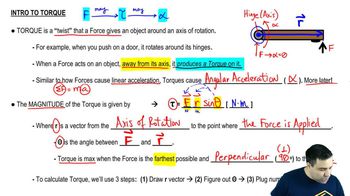
    The force applied at the handle of a rigid lever contributes to torque, which is determined by the magnitude of the force, the distance from the axis of rotation (lever arm), and the angle between the force direction and the lever arm. The torque is calculated using T = F * r * sin(theta).
  • What is an example of a variable torque load?

    An example of a variable torque load is a door being pushed at different points or angles, where the torque changes depending on the distance from the hinge and the angle at which the force is applied.
  • What is a torque wrench also known as?

    A torque wrench is also known as a tool used to apply a specific amount of torque to a fastener, such as a nut or bolt, ensuring proper tightness.
  • What is the sequence of events that leads from applying a force to causing angular acceleration in an object?

    Applying a force produces a torque, which then results in angular acceleration (alpha). This sequence is force → torque → angular acceleration.
  • Why does pushing on a door at the hinge fail to produce any torque?

    Pushing at the hinge means the lever arm (r) is zero, so the torque is zero regardless of the force applied. No rotation occurs because there is no distance from the axis of rotation.
  • How does the angle between the force and the lever arm affect the value of torque produced?

    The torque is maximized when the force is applied perpendicular to the lever arm (theta = 90 degrees), making sin(theta) equal to 1. If the angle is 0 or 180 degrees, sin(theta) is zero and no torque is produced.
  • What are the units of torque, and how are they derived from the torque formula?

    Torque is measured in newton-meters (N·m). This comes from multiplying force (newtons) by distance (meters) in the formula T = F * r * sin(theta).
  • Why is it easier to open a door by pushing at the edge farthest from the hinge rather than near the hinge?

    The farther from the hinge you apply the force, the larger the lever arm (r), which increases the torque for the same force. This makes it easier to rotate the door.
  • What common mistake should you avoid when identifying the angle to use in the torque equation?

    You should avoid blindly using the given angle without checking if it is actually the angle between the force vector and the lever arm vector. Always ensure the angle used is specifically between these two vectors.
  • How can shifting the representation of vectors help clarify the correct angle for torque calculations?

    By redrawing vectors so their tails originate from the same point, you can clearly see the angle between them. This helps ensure you use the correct angle in the torque formula.