Pearson+ LogoPearson+ Logo

Satellite Motion: Intro quiz #1 Flashcards

Satellite Motion: Intro quiz #1
Control buttons has been changed to "navigation" mode.
1/10
  • Is the Sun moving, and how does this relate to the concept of satellites in orbital motion?

    Yes, the Sun is moving. In the context of satellite motion, any object that orbits another is considered a satellite. For example, the Earth orbits the Sun, making the Earth a satellite of the Sun. Similarly, the Sun itself moves as part of the galaxy, and objects can orbit it due to gravitational forces.
  • What determines the shape of a satellite's orbit around the Earth, and what are the possible types of orbits?

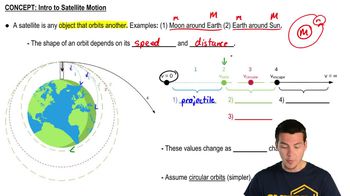
    The shape of a satellite's orbit around the Earth is determined by its speed and its distance from the Earth. If the satellite's speed is exactly the circular orbital speed for its altitude, it will have a circular orbit. If its speed is between the minimum orbital speed and the escape velocity (but not exactly the circular speed), the orbit will be elliptical. If the speed is less than the minimum orbital speed, the object will fall back to Earth as a projectile. If the speed equals or exceeds escape velocity, the object will escape Earth's gravity and not return.
  • How does the altitude of a satellite, such as the space shuttle orbiting 300 km above Earth's surface, affect its required orbital speed?

    The required orbital speed for a satellite decreases as its altitude above Earth's surface increases. For example, the space shuttle orbiting 300 km above the surface needs a slightly lower orbital speed than a satellite orbiting just above the surface, because gravitational force is weaker at higher altitudes. The exact speed can be calculated using the formula for circular orbital speed, which depends on the mass of the Earth and the distance from Earth's center to the satellite.
  • What happens to an object launched horizontally from a tower at a speed less than the minimum orbital speed?

    It will follow a curved path and eventually hit the ground as a projectile. This is because gravity pulls it down before it can complete an orbit.
  • How did Newton's thought experiment with a cannon help explain satellite motion?

    Newton imagined firing a cannonball at increasing speeds from a tall tower to illustrate how different velocities result in different orbital paths. This helped show that with enough speed, an object could continuously fall around Earth, creating an orbit.
  • What is the significance of the 'minimum speed required for an orbit' in satellite motion?

    It is the lowest speed at which an object can travel horizontally and not crash into the planet, instead continuously falling around it. This speed allows the object to just barely avoid the surface due to the planet's curvature.
  • If a satellite's launch speed is greater than the escape velocity, what is its fate?

    The satellite will escape the planet's gravitational pull and never return. Its path is not considered an orbit but rather an escape trajectory.
  • How does increasing the height from which a satellite is launched affect the required orbital and escape speeds?

    Both the required orbital and escape speeds decrease as the launch height increases. This is because gravitational force weakens with distance from the planet's center.
  • Why are circular orbits often assumed in satellite motion problems unless otherwise specified?

    Assuming circular orbits simplifies calculations and is a common approximation. Unless the problem states otherwise, this assumption is used for convenience.
  • In the example of a mysterious planet, what type of path does a 6,000 m/s launch speed produce if the escape speed is 10,000 m/s?

    A 6,000 m/s launch speed results in an elliptical orbit because it is above the minimum orbital speed but below the escape speed. The orbit will be larger than one at a lower speed but still bound to the planet.