Satellite Motion: Speed & Period definitions Flashcards

Satellite Motion: Speed & Period definitions
Control buttons has been changed to "navigation" mode.
1/15
  • Orbital Speed
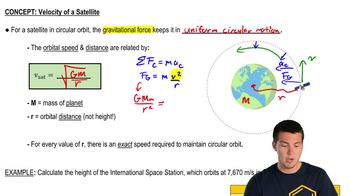
    The velocity required for a satellite to maintain a stable circular orbit around a planet.
  • Gravitational Constant
    A universal constant (G) used in the calculation of gravitational forces between two masses.
  • Orbital Period
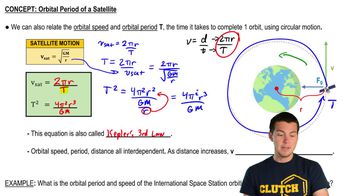
    The time it takes for a satellite to complete one full orbit around a planet.
  • Centripetal Acceleration
    The acceleration directed towards the center of a circular path, maintaining circular motion.
  • Uniform Circular Motion
    Motion in a circular path at constant speed, requiring centripetal force.
  • Kepler's Third Law
    A law relating the square of the orbital period to the cube of the orbital radius.
  • Tangential Velocity
    The component of velocity parallel to the circular path of a satellite.
  • Orbital Distance
    The distance from the center of a planet to a satellite in orbit.
  • International Space Station
    A satellite orbiting Earth at about 400 km, with a period of 1.5 hours and speed of 7660 m/s.
  • Newton's Law of Gravity
    A law stating the gravitational force between two masses is proportional to their product and inversely proportional to the square of their distance.
  • Circumference
    The distance around a circular path, calculated as 2π times the radius.
  • Mass of the Planet
    The mass of the celestial body around which a satellite orbits, crucial for calculating orbital speed.
  • Height Above Earth
    The altitude of a satellite's orbit above Earth's surface, calculated using orbital parameters.
  • Radius of the Earth
    The distance from Earth's center to its surface, used in calculating satellite orbits.
  • Orbital Mechanics
    The study of the motion of satellites and celestial bodies under gravitational forces.