How long does it take Earth to complete one orbit around the Sun?
Earth takes approximately one year, or about 365.25 days, to complete one orbit around the Sun.
Why must a geostationary satellite orbit Earth with a period equal to one sidereal day?
A geostationary satellite must orbit Earth with a period equal to one sidereal day so that it remains fixed above the same point on Earth's equator, matching Earth's rotation and appearing stationary relative to the surface.
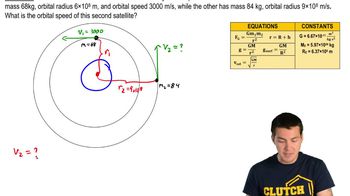
How can you determine the time it takes for two objects, such as a star and a planet, to complete one orbit around their common center of mass?
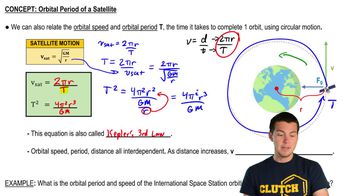
The time it takes for two objects to complete one orbit around their common center of mass is given by the orbital period, which can be calculated using Kepler's Third Law: T^2 = (4π^2/GM) * R^3, where T is the period, G is the gravitational constant, M is the total mass, and R is the orbital radius.
How long does it take the Moon to complete one orbit around the Earth?
The Moon takes about 27.3 days to complete one orbit around the Earth, which is known as a sidereal month.
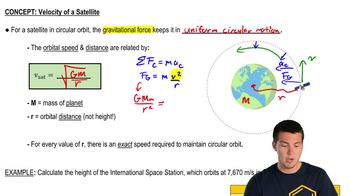
Which factor is not needed when calculating the velocity of a satellite orbiting a planet?
The mass of the satellite is not needed when calculating the orbital velocity; only the gravitational constant, the mass of the planet, and the orbital radius are required.
How does friction with the atmosphere affect the speed of an artificial satellite?
Friction with the atmosphere causes an artificial satellite to lose energy, which decreases its speed and can cause it to spiral toward the planet.
Which change would cause the greatest increase in the acceleration of a satellite in orbit?
Decreasing the orbital radius (bringing the satellite closer to the planet) would cause the greatest increase in the satellite's acceleration, since gravitational acceleration increases as distance decreases.
If the International Space Station makes 15.65 revolutions per day in its orbit around the Earth, what is its approximate orbital period?
The orbital period is the reciprocal of the number of revolutions per day: T = 24 hours / 15.65 ≈ 1.53 hours per revolution.
How does the orbital period of a satellite change as its orbital radius increases?
As the orbital radius increases, the orbital period increases according to Kepler's Third Law: T^2 ∝ R^3. Therefore, satellites farther from the planet have longer periods.
What is the relationship between the gravitational force and the centripetal force for a satellite in a stable circular orbit?
The gravitational force acting on the satellite provides the necessary centripetal force to keep it in uniform circular motion. This means that the gravitational force equals the centripetal force required for the satellite's orbit.