How do you calculate the dot product of two vectors given in component form, such as a = 2.0i - 4.0j + 5.0k and b = 11.0i + 2.5j?
To calculate the dot product of two vectors in component form, multiply corresponding components and sum the results: a · b = (a_x)(b_x) + (a_y)(b_y) + (a_z)(b_z). For a = 2.0i - 4.0j + 5.0k and b = 11.0i + 2.5j, the dot product is (2.0)(11.0) + (-4.0)(2.5) + (5.0)(0) = 22.0 - 10.0 + 0 = 12.0.
What is the general formula for the scalar (dot) product of two vectors, and how does the angle between the vectors affect the result?
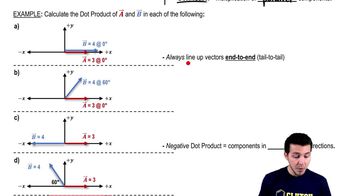
The general formula for the dot product of two vectors A and B is: A · B = |A| |B| cos(θ), where |A| and |B| are the magnitudes of the vectors and θ is the smallest angle between them. The dot product is maximized when the vectors are parallel (θ = 0°), zero when they are perpendicular (θ = 90°), and negative when they are anti-parallel (θ = 180°).
What is the result of the dot product of two vectors when they are perfectly perpendicular to each other?
The result is zero because the cosine of 90 degrees is zero. This means there are no parallel components between the vectors.
How do you determine the angle to use in the dot product formula when the vectors are not aligned along standard axes?
You use the smallest angle between the two vectors, regardless of their orientation. This angle is always measured from one vector to the other tail-to-tail.
What does a negative value for the dot product indicate about the directions of the two vectors involved?
A negative dot product means the vectors have components pointing in opposite directions. This occurs when the angle between them is greater than 90 degrees and up to 180 degrees.
When calculating the dot product, why is it important to ensure your calculator is in degrees mode?
Because the angle in the dot product formula is typically given in degrees, using the wrong mode can result in incorrect cosine values. This would lead to an incorrect calculation of the dot product.
How can you interpret the dot product in terms of multiplying parallel components of vectors?
The dot product can be thought of as multiplying the magnitude of one vector by the component of the other vector that is parallel to it. This highlights how only the parallel parts contribute to the result.
What happens to the dot product if one of the vectors is reversed in direction while keeping their magnitudes the same?
The dot product becomes negative because the angle between the vectors becomes 180 degrees. The cosine of 180 degrees is -1, flipping the sign of the result.
If two vectors are not completely parallel or anti-parallel, how does the angle between them affect the dot product?
The dot product is scaled by the cosine of the angle between the vectors, so as the angle increases from 0 to 90 degrees, the result decreases from maximum to zero. For angles between 90 and 180 degrees, the result becomes negative.
Why does the dot product of two vectors result in a scalar rather than a vector?
The dot product combines the magnitudes and the cosine of the angle between the vectors, yielding a single number. This scalar represents the extent to which the vectors point in the same direction.