Series LRC Circuits definitions Flashcards

Series LRC Circuits definitions
Control buttons has been changed to "navigation" mode.
1/15
  • Series LRC Circuit
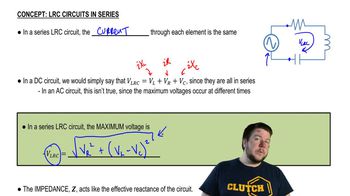
    A circuit with inductors, resistors, and capacitors connected in series to an AC source.
  • Inductor
    A component that stores energy in a magnetic field when electric current flows through it.
  • Resistor
    A component that opposes the flow of electric current, causing energy dissipation as heat.
  • Capacitor
    A component that stores energy in an electric field, capable of releasing it when needed.
  • AC Source
    A power supply that provides alternating current, where the flow of electric charge periodically reverses direction.
  • Maximum Voltage
    The peak voltage value in a circuit, calculated using a specific formula involving resistors, inductors, and capacitors.
  • Impedance
    The effective resistance in an AC circuit, crucial for determining the maximum current from the source.
  • RMS Voltage
    The root mean square voltage, a measure of the effective value of an AC voltage.
  • Angular Frequency
    The rate of change of the phase of a sinusoidal waveform, calculated as 2π times the linear frequency.
  • Kirchhoff's Loop Rule
    A principle stating that the sum of the voltages around any closed loop in a circuit must equal zero.
  • Reactance
    The opposition to the change in current by inductors and capacitors in an AC circuit.
  • Effective Reactance
    The combined opposition to current flow in a series LRC circuit, represented by impedance.
  • Peak Voltage
    The maximum instantaneous value of a voltage waveform in an AC circuit.
  • Frequency
    The number of cycles per second in an AC waveform, measured in hertz (Hz).
  • Ohm
    The unit of electrical resistance, representing the resistance between two points of a conductor.