Pearson+ LogoPearson+ Logo

Simple Harmonic Motion of Pendulums quiz #1 Flashcards

Simple Harmonic Motion of Pendulums quiz #1
Control buttons has been changed to "navigation" mode.
1/10
  • For a simple harmonic oscillator such as a pendulum, at what position during its motion is the acceleration zero?

    The acceleration of a simple harmonic oscillator, like a pendulum, is zero at the equilibrium position, which is the midpoint of its swing where the displacement from equilibrium is zero.
  • Given a simple pendulum made from a string of length 0.65 meters, what is the formula for its period of oscillation?

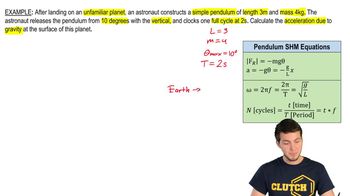
    The period of oscillation for a simple pendulum of length L is given by T = 2π√(L/g), where L is the length of the string and g is the acceleration due to gravity.
  • What is the mathematical relationship between the horizontal displacement x and the angle theta for a pendulum of length l?

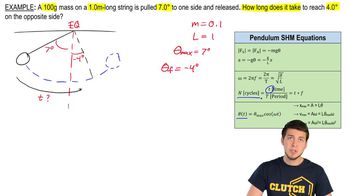
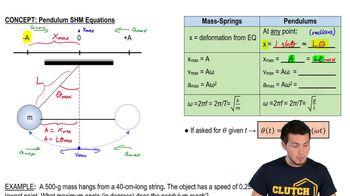
    The horizontal displacement x is given by x = l * theta, where theta is in radians. This approximation holds for small angles.
  • Why must the angle theta be in radians when using pendulum equations involving sine or angular displacement?

    Pendulum equations assume theta is in radians because the small-angle approximation sin(theta) ≈ theta only holds in radians. Using degrees would yield incorrect results.
  • How do you convert an angle from degrees to radians for use in pendulum calculations?

    To convert degrees to radians, multiply the angle in degrees by π/180. This ensures the angle is in the correct unit for the equations.
  • At what point during a pendulum's swing does it reach its maximum speed, and how long does it take to get there from the amplitude position?

    The pendulum reaches its maximum speed at the lowest point of its swing. It takes one quarter of the period (T/4) to travel from the amplitude position to this point.
  • What is the formula for the maximum velocity of a pendulum in terms of its length, maximum angle, and angular frequency?

    The maximum velocity v_max is given by v_max = l * theta_max * omega, where l is the length, theta_max is the maximum angle in radians, and omega is the angular frequency. This formula parallels the mass-spring system's v_max = A * omega.
  • How do you determine the maximum angle a pendulum reaches if you know its maximum speed, length, and angular frequency?

    The maximum angle theta_max is found by rearranging the velocity formula: theta_max = v_max / (l * omega). This gives theta_max in radians, which can be converted to degrees if needed.
  • What is the small-angle approximation and why is it important in analyzing pendulum motion?

    The small-angle approximation states that sin(theta) ≈ theta for small values of theta in radians. This simplification allows the restoring force to be directly proportional to displacement, making the motion simple harmonic.
  • How does the restoring force in a pendulum differ from that in a mass-spring system, and how is it simplified for small angles?

    The restoring force in a pendulum is -mg sin(theta), while in a mass-spring system it is -kx. For small angles, the pendulum's restoring force simplifies to -mg theta, making it analogous to the spring system.