What is the general formula for the angular position of dark fringes in a single-slit diffraction pattern, and how is the width of the central bright spot determined?
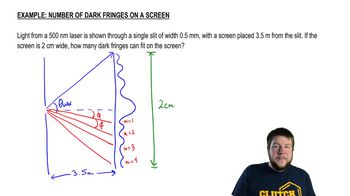
In single-slit diffraction, the angular position of the dark fringes is given by sin(θ) = mλ/d, where m = 1, 2, 3..., λ is the wavelength of light, and d is the width of the slit. The width of the central bright spot on a screen at distance L from the slit is found by first calculating the angle θ₁ for the first dark fringe (m = 1), then using y₁ = L·tan(θ₁) to find the distance from the central axis to the first dark fringe. The total width of the central bright spot is 2y₁.
How does the width of the central bright spot in single slit diffraction compare to the other bright spots?
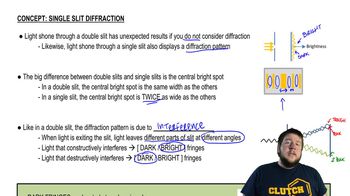
The central bright spot is twice as wide as the other bright spots. It is also considerably brighter than the others.
What is the main difference in the diffraction pattern between single slit and double slit experiments regarding the central bright spot?
In a single slit experiment, the central bright spot is larger and brighter than the others, while in a double slit experiment, all bright spots are of equal width. This difference is a key distinguishing feature between the two patterns.
Why do dark fringes occur in a single slit diffraction pattern?
Dark fringes occur due to destructive interference, where a peak from one wave meets a trough from another. This results in a reduced amplitude and thus a dark spot on the screen.
In the context of single slit diffraction, what does the variable 'd' represent?
'd' represents the width of the single slit. This is different from the double slit experiment, where 'd' is the distance between the two slits.
Why is there no m = 0 dark fringe in single slit diffraction?
There is no m = 0 dark fringe because m = 0 corresponds to the central maximum, not a dark fringe. The indexing for dark fringes starts at m = 1.
What trigonometric function is used to relate the position of a dark fringe to the geometry of the setup in single slit diffraction?
The tangent function is used, specifically tan(θ) = y/L, where y is the distance from the central axis to the dark fringe and L is the distance to the screen. This allows calculation of the fringe position on the screen.
How do you calculate the width of a non-central bright fringe in a single slit diffraction pattern?
The width of a non-central bright fringe is equal to the distance from the central axis to the first dark fringe, denoted as y1. This is half the width of the central bright spot.
What physical principle causes the alternating bright and dark spots in single slit diffraction?
The alternating pattern is caused by interference of light waves leaving different parts of the slit at different angles. Constructive interference creates bright spots, while destructive interference creates dark spots.
How does the calculation of single slit diffraction fringe positions differ from that of double slit diffraction?
In single slit diffraction, there is only an equation for the dark fringes, not for the bright fringes. In double slit diffraction, separate equations exist for both bright and dark fringe positions.