Solving Projectile Motion Using Energy definitions Flashcards
Solving Projectile Motion Using Energy definitions
You can tap to flip the card.
Control buttons has been changed to "navigation" mode.
1/15
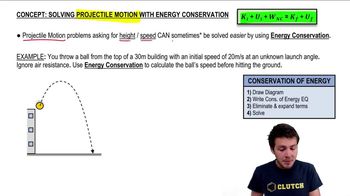
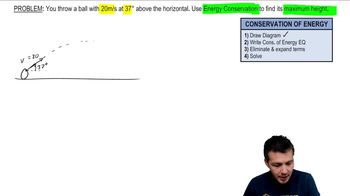
Energy ConservationA principle stating that the total energy in an isolated system remains constant over time.Projectile MotionThe motion of an object thrown or projected into the air, subject to only the acceleration of gravity.Kinetic EnergyThe energy possessed by an object due to its motion, calculated as 1/2 mv^2.Potential EnergyThe energy held by an object because of its position relative to other objects, stress within itself, electric charge, or other factors.Gravitational Potential EnergyEnergy an object possesses due to its position in a gravitational field, often calculated as mgh.Non-conservative WorkWork done by forces that do not conserve mechanical energy, such as friction or air resistance.Initial SpeedThe speed of an object at the start of a time interval, often denoted as v_a.Final SpeedThe speed of an object at the end of a time interval, often denoted as v_d.Launch AngleThe angle at which an object is projected into the air relative to the horizontal.HeightThe vertical distance of an object above a reference point, often the ground.MassA measure of the amount of matter in an object, typically in kilograms.VelocityThe speed of something in a given direction.Acceleration due to GravityThe acceleration of an object caused by Earth's gravity, approximately 9.8 m/s^2.Symmetrical PointThe point in projectile motion where the object returns to its initial height.Square RootA value that, when multiplied by itself, gives the original number.