Skip to main content
Physics with Calculus
My Course
Learn
Exam Prep
AI Tutor
Study Guides
Textbook Solutions
Flashcards
Explore
Try the app
My Course
Learn
Exam Prep
AI Tutor
Study Guides
Textbook Solutions
Flashcards
Explore
Try the app
Back
Solving Resistor Circuits definitions
You can tap to flip the card.
Equivalent Resistance
You can tap to flip the card.
👆
Equivalent Resistance
The total resistance of a circuit that combines multiple resistors into a single resistor.
Track progress
Control buttons has been changed to "navigation" mode.
1/15
Related flashcards
Related practice
Recommended videos
Solving Resistor Circuits quiz
Solving Resistor Circuits
15 Terms
Solving Resistor Circuits
27. Resistors & DC Circuits
6 problems
Topic
Patrick
Kirchhoff's Loop Rule
27. Resistors & DC Circuits
6 problems
Topic
Patrick
27. Resistors & DC Circuits - Part 1 of 2
4 topics
12 problems
Chapter
Patrick
27. Resistors & DC Circuits - Part 2 of 2
5 topics
14 problems
Chapter
Patrick
Guided course
17:24
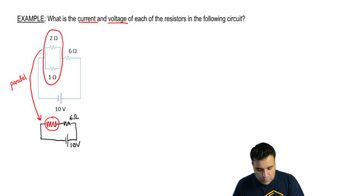
Solving Resistor Circuits
12084
views
180
rank
13
comments
Guided course
01:49
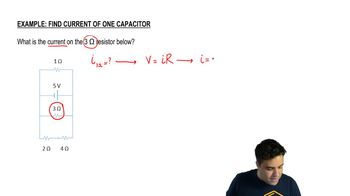
Find Current of One Resistor
7699
views
123
rank
5
comments
Terms in this set (15)
Hide definitions
Equivalent Resistance
The total resistance of a circuit that combines multiple resistors into a single resistor.
Series Connection
A circuit configuration where resistors are arranged in a single path, sharing the same current.
Parallel Connection
A circuit configuration where resistors are connected across the same two points, sharing the same voltage.
Ohm's Law
A fundamental equation in electronics, V=IR, relating voltage, current, and resistance.
Current
The flow of electric charge through a conductor, measured in amperes (amps).
Voltage
The electric potential difference between two points, measured in volts.
Resistor
A component that resists the flow of electric current, causing a voltage drop.
Shortcut Equation
A simplified formula used to quickly calculate equivalent resistance in parallel circuits.
Merged Resistor
A single resistor that represents the combined resistance of multiple resistors.
Systematic Approach
A methodical process for solving circuit problems to ensure accuracy and avoid confusion.
Kirchhoff's Junction Rule
A principle stating that the total current entering a junction equals the total current leaving.
Node
A point in a circuit where two or more components are connected.
Resistance
A measure of how much a component opposes the flow of current, measured in ohms.
Battery
A device that provides a constant voltage source in a circuit.
Current Split
The division of current at a junction in a parallel circuit.
 BackBack
 17:24
17:24