Skip to main content
Physics with Calculus
My Course
Learn
Exam Prep
AI Tutor
Study Guides
Textbook Solutions
Flashcards
Explore
Try the app
My Course
Learn
Exam Prep
AI Tutor
Study Guides
Textbook Solutions
Flashcards
Explore
Try the app
Back
Special Equations in Symmetrical Launches definitions
You can tap to flip the card.
Symmetrical Launch
You can tap to flip the card.
👆
Symmetrical Launch
A type of projectile motion where the final height equals the initial height, with equal ascent and descent times.
Track progress
Control buttons has been changed to "navigation" mode.
1/15
Related flashcards
Related practice
Recommended videos
Special Equations in Symmetrical Launches quiz
Special Equations in Symmetrical Launches
15 Terms
Special Equations in Symmetrical Launches
5. Projectile Motion
1 problem
Topic
Positive (Upward) Launch
5. Projectile Motion
6 problems
Topic
Patrick
5. Projectile Motion
6 topics
14 problems
Chapter
Patrick
Guided course
03:34
A Long Jump on Planet X
4182
views
38
rank
2
comments
Guided course
07:51
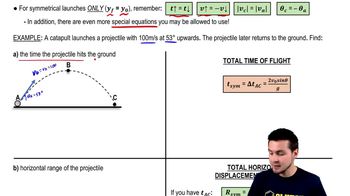
Using Special Equations in Symmetrical Launch Problems
6878
views
69
rank
2
comments
Terms in this set (15)
Hide definitions
Symmetrical Launch
A type of projectile motion where the final height equals the initial height, with equal ascent and descent times.
Initial Velocity
The speed at which a projectile is launched, often denoted as V0.
Launch Angle
The angle at which a projectile is launched relative to the horizontal.
Acceleration due to Gravity
The constant acceleration experienced by an object in free fall, typically 9.8 m/s² on Earth.
Total Time of Flight
The total duration a projectile is in motion from launch to landing.
Horizontal Range
The total horizontal distance covered by a projectile during its flight.
Range Equation
An equation to calculate the horizontal range: R = V0² * sin(2*theta) / g.
Complementary Angles
Two angles whose sum is 90 degrees, yielding the same range for a given initial velocity.
Maximum Range
The greatest horizontal distance achieved by a projectile, occurring at a 45-degree launch angle.
Vertical Component
The part of the initial velocity acting in the vertical direction, calculated as V0 * sin(theta).
Horizontal Component
The part of the initial velocity acting in the horizontal direction, calculated as V0 * cos(theta).
Projectile Motion
The motion of an object thrown or projected into the air, subject to only the acceleration of gravity.
Displacement
The change in position of a projectile, often measured as the horizontal range.
UAM Equations
Uniformly Accelerated Motion equations used to describe motion with constant acceleration.
Negative Velocity
The velocity of a projectile when it is descending, equal in magnitude but opposite in direction to the initial upward velocity.
 BackBack
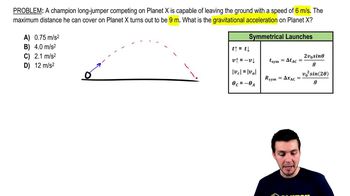
 03:34
03:34