Skip to main content
Physics with Calculus
My Course
Learn
Exam Prep
AI Tutor
Study Guides
Textbook Solutions
Flashcards
Explore
Try the app
My Course
Learn
Exam Prep
AI Tutor
Study Guides
Textbook Solutions
Flashcards
Explore
Try the app
Back
Special Vs. Galilean Relativity definitions
You can tap to flip the card.
Galilean Relativity
You can tap to flip the card.
👆
Galilean Relativity
A classical theory where velocities are additive, established by Galileo and solidified by Newton.
Track progress
Control buttons has been changed to "navigation" mode.
1/15
Related flashcards
Related practice
Recommended videos
Special Vs. Galilean Relativity quiz #1
Special Vs. Galilean Relativity
10 Terms
Special Vs. Galilean Relativity
36. Special Relativity
4 problems
Topic
Patrick
Consequences of Relativity
36. Special Relativity
3 problems
Topic
Patrick
35. Special Relativity
4 topics
10 problems
Chapter
Patrick
Guided course
17:25
Special Vs. Galilean Relativity
3216
views
33
rank
2
comments
Terms in this set (15)
Hide definitions
Galilean Relativity
A classical theory where velocities are additive, established by Galileo and solidified by Newton.
Special Relativity
Einstein's theory that modifies Galilean Relativity, especially at velocities near the speed of light.
Inertial Frame
A reference frame where the laws of physics are consistent and not influenced by external forces.
Michelson-Morley Experiment
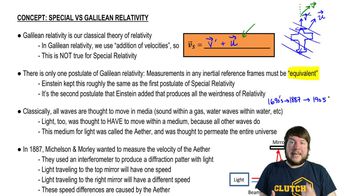
An 1887 experiment that failed to detect ether, supporting the constancy of light speed in a vacuum.
Ether
A hypothesized medium for light waves, disproven by the Michelson-Morley experiment.
Time Dilation
A phenomenon where time is measured differently in different inertial frames, a result of Special Relativity.
Length Contraction
A phenomenon where distances are measured differently in different inertial frames, a result of Special Relativity.
Speed of Light
A constant value in all inertial frames, central to Einstein's second postulate of Special Relativity.
Beam Splitter
A device that divides a beam of light into two paths, used in the Michelson-Morley experiment.
Interference Pattern
A pattern resulting from the superposition of different light waves, used to detect ether.
Proper Frame
A reference frame where an object is at rest, used to measure its intrinsic properties.
Lab Frame
A reference frame at rest with respect to the Earth's surface, used for external observations.
Velocity Addition
The concept in Galilean Relativity where velocities are summed, not applicable in Special Relativity.
Coherent Light
Light waves that maintain a constant phase relationship, crucial for interference experiments.
Postulate
A fundamental assumption in a theory, such as the constancy of light speed in Special Relativity.
 BackBack
 17:25
17:25