Pearson+ LogoPearson+ Logo

Special Vs. Galilean Relativity quiz #1 Flashcards

Special Vs. Galilean Relativity quiz #1
Control buttons has been changed to "navigation" mode.
1/10
  • What are the key postulates and consequences of Einstein's Special Relativity, and how do they differ from Galilean Relativity?

    Einstein's Special Relativity is based on two postulates: (1) the laws of physics are the same in all inertial frames, and (2) the speed of light in a vacuum is constant and independent of the motion of the source or observer, in all inertial frames. Unlike Galilean Relativity, which uses simple addition of velocities and allows for speeds exceeding the speed of light, Special Relativity modifies velocity addition so that no object can exceed the speed of light. Special Relativity also leads to phenomena such as time dilation and length contraction, meaning that measurements of time and space depend on the observer's inertial frame. These effects are not present in Galilean Relativity.
  • What is the main difference in how velocities are combined in Galilean relativity versus special relativity?

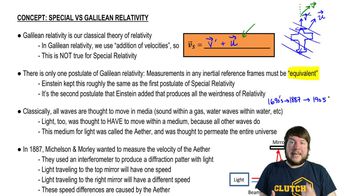
    In Galilean relativity, velocities are simply added together, while in special relativity, the addition of velocities is modified so that the result never exceeds the speed of light. This ensures that no object can travel faster than light.
  • Why did physicists originally believe that light required a medium to travel through, and what was this medium called?

    Physicists believed light needed a medium because all known waves, like sound and water waves, travel through a medium. This hypothetical medium for light was called the ether.
  • What was the purpose of the Michelson-Morley experiment conducted in 1887?

    The Michelson-Morley experiment aimed to detect the velocity of the ether relative to the Earth by measuring differences in the speed of light in different directions. Their goal was to find evidence for the existence of the ether.
  • What did the Michelson-Morley experiment ultimately reveal about the ether?

    The experiment found no evidence for the existence of the ether, as the speed of light was measured to be the same in all directions and at all times. This result led to the conclusion that light does not require a medium to travel.
  • How does the speed of light behave when measured in different inertial frames according to special relativity?

    According to special relativity, the speed of light is always measured to be the same value in all inertial frames, regardless of the motion of the source or observer. This is a direct consequence of Einstein's second postulate.
  • What is meant by the 'proper frame' when discussing reference frames in relativity?

    The proper frame is the reference frame in which the object of interest is at rest. Measurements made in this frame are considered the object's proper measurements.
  • How does Galilean relativity explain the observed speed of a ball thrown from a moving car?

    Galilean relativity states that the observed speed of the ball is the sum of the car's speed and the speed at which the ball is thrown relative to the car. This simple addition works well at everyday speeds.
  • What are the two major phenomena that arise from the second postulate of special relativity?

    The two major phenomena are time dilation and length contraction. These effects mean that measurements of time and distance depend on the observer's inertial frame.
  • Why is the constancy of the speed of light considered 'weird' compared to everyday experiences with motion?

    In everyday experiences, we expect velocities to add together, but the speed of light remains constant regardless of the observer's motion. This contradicts our intuition and the rules of classical physics.