Intro to Springs (Hooke's Law) definitions Flashcards
Intro to Springs (Hooke's Law) definitions
You can tap to flip the card.
Control buttons has been changed to "navigation" mode.
1/15
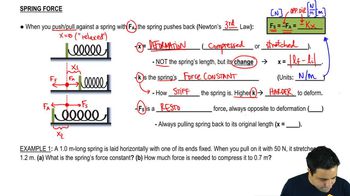
Spring ConstantA measure of a spring's stiffness, indicating the force needed to change its length by one meter, with units in Newtons per meter (N/m).DeformationThe change in length of a spring from its original length, either by compression or stretching.Restoring ForceThe force exerted by a spring to return to its original length, acting opposite to the direction of deformation.EquilibriumThe state where the forces on a spring balance out, resulting in no net force and no acceleration.Hooke's LawThe principle stating that the force exerted by a spring is proportional to its deformation, expressed as F = -kx.Newton's Third LawThe law stating that for every action, there is an equal and opposite reaction.Vertical SpringA spring oriented vertically, where its deformation is influenced by gravitational force on an attached mass.CompressionThe act of shortening a spring's length by applying a force.StretchingThe act of elongating a spring's length by applying a force.Relaxed PositionThe state of a spring when it is at its original length, with no deformation.Force of SpringThe force exerted by a spring, calculated as the product of the spring constant and deformation.MassThe quantity of matter in an object, which influences the gravitational force acting on a spring.Gravitational ForceThe force exerted by the Earth on a mass, calculated as the product of mass and gravitational acceleration.OscillationThe repetitive variation in position of a spring around its equilibrium point when disturbed.Force ConstantAnother term for spring constant, indicating the stiffness of a spring.