Intro to Springs (Hooke's Law) quiz #1 Flashcards

Intro to Springs (Hooke's Law) quiz #1
Control buttons has been changed to "navigation" mode.
1/31
  • Which form of energy increases when a spring is compressed or stretched?
    The elastic potential energy stored in the spring increases when it is compressed or stretched.
  • How does an elastic material exert elastic force when deformed?
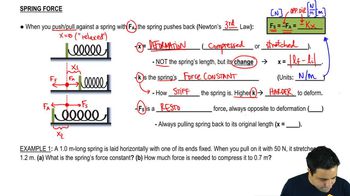
    An elastic material exerts an elastic (restoring) force that acts in the direction opposite to the deformation, attempting to return the material to its original, undeformed length.
  • If the spring constant of a spring is doubled, how does this affect the force required to produce the same deformation?
    Doubling the spring constant means the force required for the same deformation also doubles, since force is proportional to the spring constant (F = kx).
  • What spring constant should be specified when describing a spring's stiffness?
    The spring constant 'k', measured in Newtons per meter (N/m), should be specified to describe a spring's stiffness.
  • In Hooke's Law, what does the equation F_s = -kx represent?
    In Hooke's Law, F_s = -kx represents the restoring force exerted by a spring, where 'k' is the spring constant and 'x' is the deformation from the spring's relaxed position. The negative sign indicates the force acts in the opposite direction of the deformation.
  • What is the spring constant and what does it measure?
    The spring constant 'k' measures the stiffness of a spring, indicating how much force is needed to stretch or compress the spring by one meter. Its units are Newtons per meter (N/m).
  • If a spring is stretched three times as far as its original deformation, how does the energy stored in the spring change?
    The energy stored in a spring is proportional to the square of the deformation (U = 1/2 kx^2). If the deformation is tripled, the energy increases by a factor of nine.
  • What happens to the force needed to stretch an elastic object as the deformation increases?
    The force needed to stretch an elastic object increases linearly with the deformation, according to F = kx.
  • What is the equation for the potential energy stored in a spring when it is stretched or compressed?
    The potential energy stored in a spring is given by U = (1/2) k x^2, where 'k' is the spring constant and 'x' is the deformation.
  • Why is a metal spring said to be elastic?
    A metal spring is said to be elastic because it returns to its original shape after being stretched or compressed, exerting a restoring force proportional to the deformation.
  • When a mass attached to a spring is at maximum displacement, what is true about the spring's force?
    At maximum displacement, the spring exerts its maximum restoring force, which is directed opposite to the displacement.
  • How can you determine the spring constant k of a spring being tested, such as for a baby bouncer?
    The spring constant k can be determined by measuring the force required to produce a known deformation and using the formula k = F/x.
  • Which statement best describes a spring in terms of its mechanical properties?
    A spring is an elastic object that exerts a restoring force proportional to its deformation from its relaxed position.
  • What prevents the springs in a suspension system from bouncing continuously?
    Damping mechanisms, such as shock absorbers, prevent springs in a suspension system from bouncing continuously by dissipating energy.
  • In Hooke's Law, what does the variable 'x' represent?
    In Hooke's Law, 'x' represents the deformation of the spring, which is the change in length from its original, relaxed position.
  • Where might a spring form in natural or engineered systems?
    Springs can form in engineered systems such as mechanical pens, suspension systems, and elevator safety mechanisms, wherever elastic restoring forces are needed.
  • How do you determine the length of a spring when a mass is suspended from it?
    The length of the spring is determined by the equilibrium condition kx = mg, where 'x' is the stretch from the relaxed length. The total length is the original length plus 'x'.
  • What circumstances can lead to the formation of a spring in a system?
    A spring forms when an object or material is capable of exerting a restoring force proportional to its deformation, such as in elastic materials or mechanical devices designed for elasticity.
  • What is a common setting or application for a spring?
    Common settings for springs include mechanical pens, vehicle suspension systems, and elevator safety mechanisms.
  • Why is there a negative sign in the equation for Hooke's Law?
    The negative sign in Hooke's Law indicates that the restoring force exerted by the spring acts in the direction opposite to the deformation.
  • What is the significance of the negative sign in Hooke's Law?
    The negative sign signifies that the spring's force is always directed to restore the spring to its original length, opposing the direction of deformation.
  • Which quantity increases when a metal spring is stretched horizontally?
    The elastic potential energy stored in the spring increases when it is stretched horizontally.
  • What does the spring constant measure in terms of a spring's mechanical properties?
    The spring constant measures a spring's resistance to being compressed or stretched; it quantifies the stiffness of the spring.
  • Suppose you have a mass m attached to a spring with constant k. What is the equilibrium condition for the spring's stretch?
    At equilibrium, the spring's restoring force equals the gravitational force: kx = mg, where 'x' is the stretch from the relaxed position.
  • What happens when an elastic conducting material is stretched?
    When an elastic conducting material is stretched, it exerts a restoring force proportional to the deformation, attempting to return to its original length.
  • If a block is attached to a ceiling by a spring, how is the equilibrium position determined?
    The equilibrium position is determined when the upward spring force equals the downward gravitational force: kx = mg.
  • How do you solve for the distance a spring will stretch when a mass is suspended from it?
    The stretch distance 'x' is found using the equation kx = mg, so x = mg/k.
  • If three identical springs are hanging from the ceiling, what property do they share?
    Three identical springs share the same spring constant, meaning they have the same stiffness and respond similarly to applied forces.
  • What happens when a spring lies on a horizontal table and is compressed or stretched?
    When a spring on a horizontal table is compressed or stretched, it exerts a restoring force proportional to the deformation, attempting to return to its relaxed length.
  • What occurs when a spring is hung from the ceiling and a mass is attached?
    The spring stretches until the restoring force equals the gravitational force on the mass, reaching equilibrium where kx = mg.
  • On what factors does the frequency of oscillation of a mass on a spring depend?
    The frequency of oscillation depends on the mass attached to the spring and the spring constant.