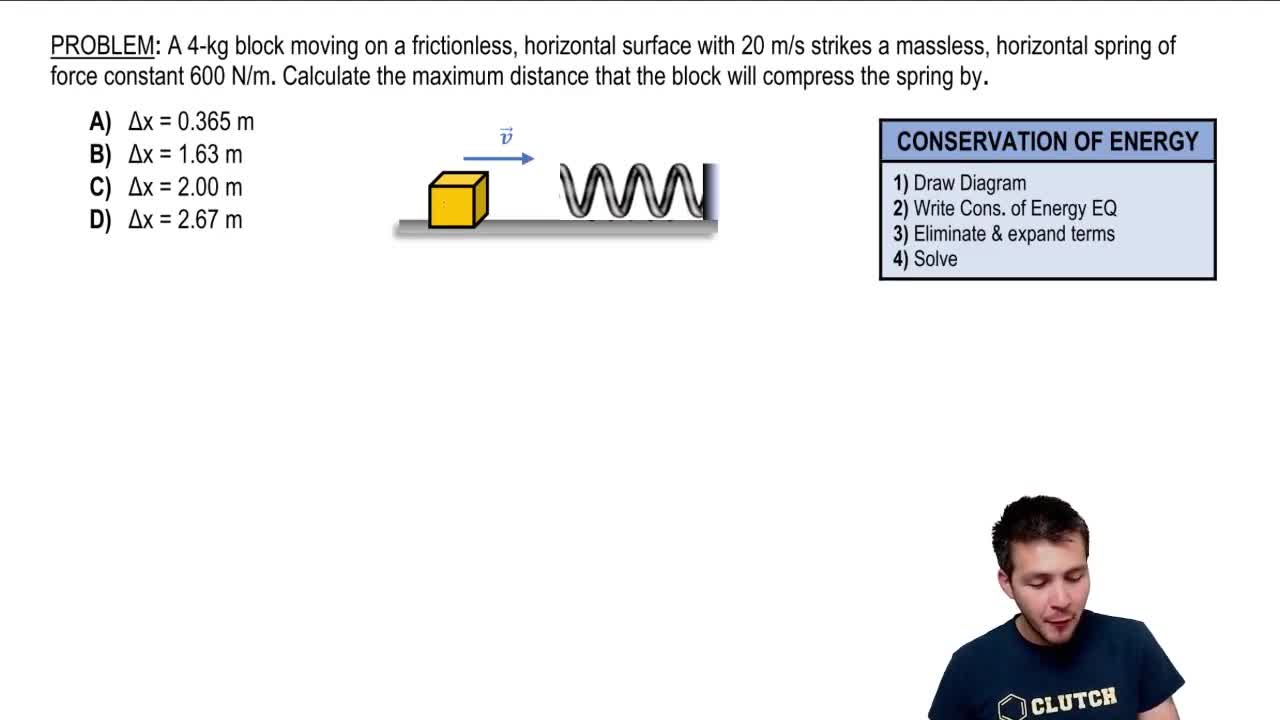
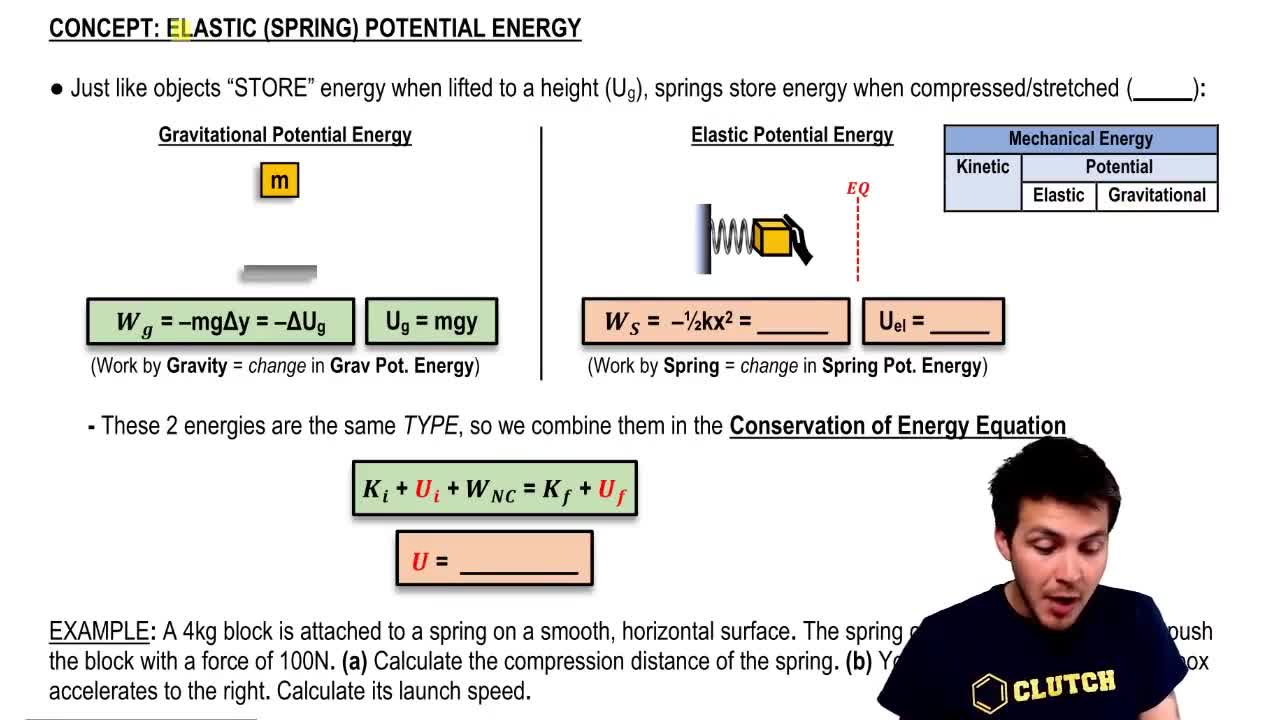
Does a stretched spring have elastic potential energy?
Yes, a stretched spring has elastic potential energy because energy is stored in the spring when it is deformed from its equilibrium position, either by stretching or compressing.
Which scenario generates the most elastic potential energy in a spring?
The scenario that generates the most elastic potential energy is when the spring is deformed (stretched or compressed) by the largest amount, since elastic potential energy is proportional to the square of the deformation (Uelastic = 1/2 k x^2).
Doubling which quantity would cause the largest increase in a spring’s elastic potential energy?
Doubling the deformation (x) of the spring would cause the largest increase in elastic potential energy, because the energy depends on the square of the deformation (Uelastic = 1/2 k x^2), so doubling x increases the energy by a factor of four.
In which scenario is elastic potential energy present in a spring?
Elastic potential energy is present in a spring whenever the spring is compressed or stretched from its equilibrium (relaxed) position.
What is the value of elastic potential energy for a spring at its equilibrium position?
The elastic potential energy is zero when the spring is at its equilibrium (relaxed) position. This is because no energy is stored unless the spring is compressed or stretched.
How does the spring force relate to the deformation of the spring according to Hooke's law?
The magnitude of the spring force is equal to the spring constant multiplied by the deformation, or F = kx. This relationship allows calculation of the compression or stretch distance.
Why can't you use constant force equations to solve for the launch speed of a block released from a compressed spring?
You can't use constant force equations because the spring force changes as the block moves, making the force non-constant. Instead, energy conservation methods must be used.
What happens to the elastic potential energy of a spring when it is released from a compressed state and returns to equilibrium?
The elastic potential energy is converted into kinetic energy as the spring returns to equilibrium. At equilibrium, the elastic potential energy becomes zero.
In a horizontal spring-block system with no friction, what types of energy are present just before and just after the block is released?
Just before release, only elastic potential energy is present because the block is stationary. Just after release, the energy is converted into kinetic energy as the block moves.
How do you calculate the compression distance of a spring when a known force is applied and the spring constant is given?
The compression distance x is found by dividing the applied force by the spring constant, or x = F/k. This uses Hooke's law for stationary situations.