Standing Wave Functions definitions Flashcards

Standing Wave Functions definitions
Control buttons has been changed to "navigation" mode.
1/15
  • Standing Wave
    A wave pattern formed by the interference of two waves traveling in opposite directions.
  • Wave Function
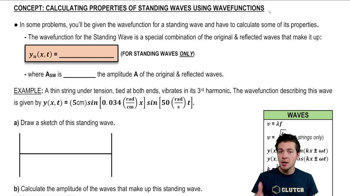
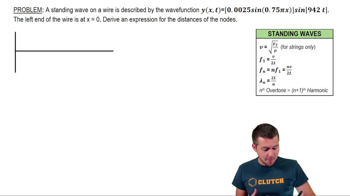
    A mathematical description of a wave, often expressed as y(x, t) = ASW * sin(kx) * sin(ωt).
  • Amplitude
    The maximum displacement of a wave from its rest position, doubled in standing waves.
  • Harmonic
    A specific frequency at which a system naturally oscillates, denoted by n.
  • Node
    A point along a standing wave where the wave has minimal amplitude.
  • Antinode
    A point where the amplitude of a standing wave is at its maximum.
  • Wave Number
    A value denoted by k, related to the wavelength by k = 2π/λ.
  • Wavelength
    The distance between consecutive points of a wave in phase, calculated as λ = 2π/k.
  • Angular Frequency
    A measure of how many radians a wave oscillates per second, denoted by ω.
  • Period
    The time taken for one complete cycle of a wave, calculated as T = 2π/ω.
  • Interference
    The process by which two waves superpose to form a resultant wave.
  • Loop
    A segment of a standing wave between two nodes, related to the harmonic number.
  • String Length
    The length of the medium supporting the wave, calculated using L = n * λn / 2.
  • Radians
    A unit of angular measure used in the context of angular frequency.
  • Oscillation
    The repetitive variation, typically in time, of some measure about a central value.