When resistors are connected in parallel, what physical quantity must be the same for both resistors?
When resistors are connected in parallel, the voltage across each resistor must be the same.
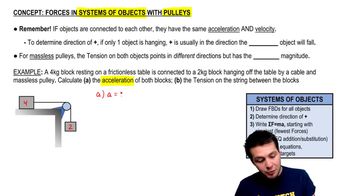
In a system where two blocks are connected by a rope and one block (block B) moves downward, what happens to the other block and what does this indicate about their accelerations?
When block B moves downward in a connected system, the other block moves in the corresponding direction dictated by the connection (such as horizontally if on a table). Both blocks have the same magnitude of acceleration because they are connected by a rope or cable.
How do you calculate the total resistance of two resistors connected in parallel, given their resistances are 15 ohms and 40 ohms?
The total resistance R_total of two resistors in parallel is calculated using the formula: 1/R_total = 1/R1 + 1/R2. For resistors of 15 ohms and 40 ohms: 1/R_total = 1/15 + 1/40.
In the context of forces acting on objects in motion, what are two examples of outside forces that could act on darts as they travel toward a dartboard?
Two examples of outside forces acting on darts in flight are gravity (weight force) and air resistance.
When a large block is pushed against a smaller block and both are in contact, how do their accelerations compare if they move together?
If a large block is pushed against a smaller block and both move together as a connected system, they have the same acceleration.
When multiple masses are connected by massless, rigid rods, how does their acceleration relate when a force is applied to the system?
When multiple masses are connected by massless, rigid rods and a force is applied, all the masses accelerate together with the same acceleration.
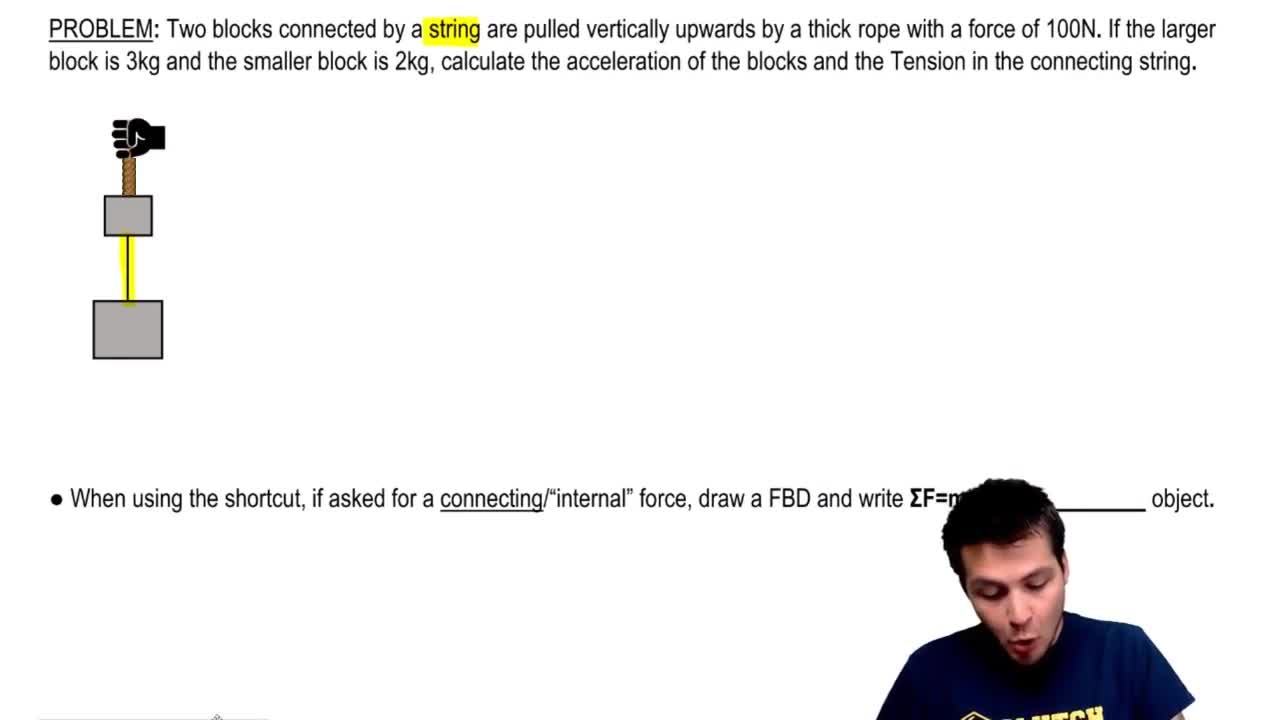
If a crate hangs from a rope attached to a metal ring, what forces act on the crate and how are they represented in a free body diagram?
The forces acting on a hanging crate are the tension force in the rope (upward) and the weight force due to gravity (downward). In a free body diagram, these are shown as an upward arrow for tension and a downward arrow for weight.
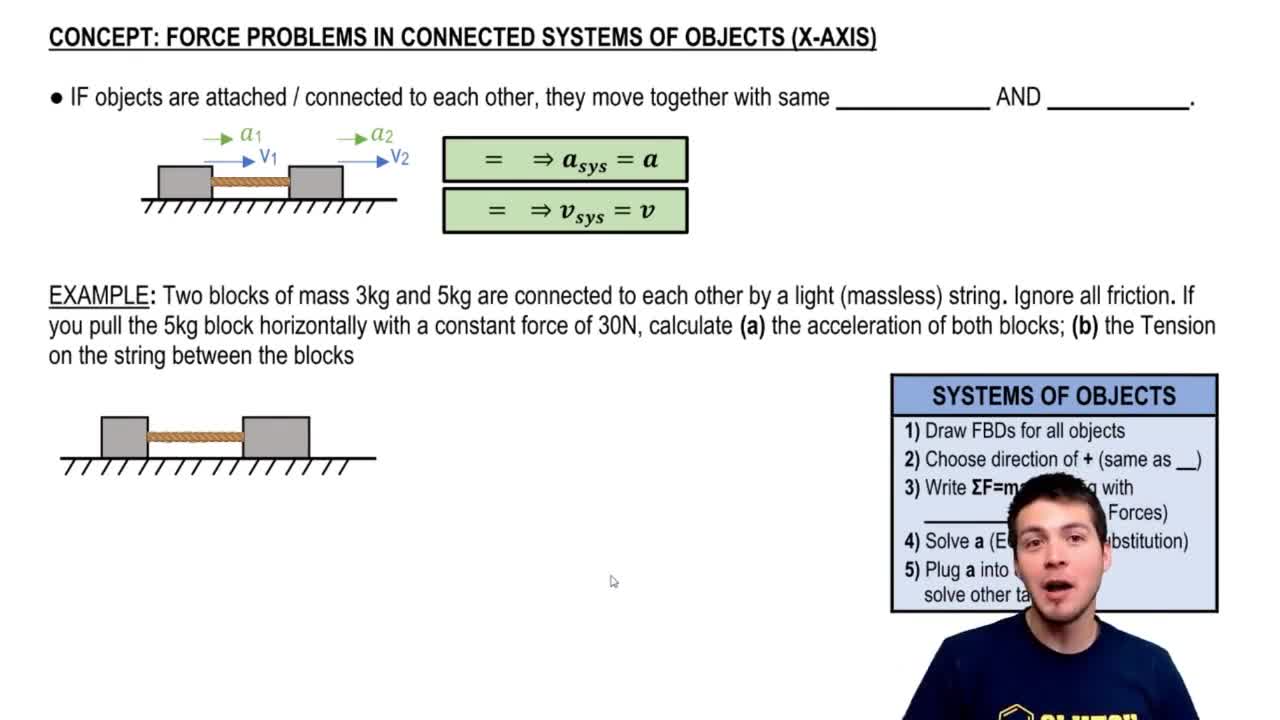
What is the first step you should take when solving a problem involving forces in a connected system of objects?
The first step is to draw free body diagrams for all objects in the system. This helps visualize all the forces acting on each object before setting up equations.
When using the shortcut method for finding acceleration in a connected system, which forces should you ignore in your calculation?
You should ignore any internal forces such as tensions or normal forces between the connected objects. Only external forces acting on the combined system are considered in the shortcut method.
How do you determine the direction of positive acceleration when objects in a pulley system move in different directions?
The direction of positive acceleration is usually chosen as the direction the hanging object will fall, and for the other object, it is the direction it will move due to the connection. This convention helps keep force equations consistent for both objects.