Skip to main content
Physics with Calculus
My Course
Learn
Exam Prep
AI Tutor
Study Guides
Textbook Solutions
Flashcards
Explore
Try the app
My Course
Learn
Exam Prep
AI Tutor
Study Guides
Textbook Solutions
Flashcards
Explore
Try the app
Back
The Doppler Effect of Light definitions
You can tap to flip the card.
Doppler Effect
You can tap to flip the card.
👆
Doppler Effect
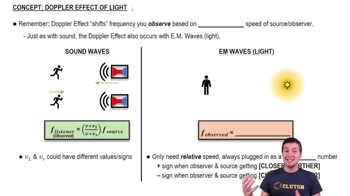
A phenomenon causing a shift in observed frequency due to relative motion between source and observer.
Track progress
Control buttons has been changed to "navigation" mode.
1/15
Related flashcards
Related practice
Recommended videos
The Doppler Effect of Light quiz
The Doppler Effect of Light
10 Terms
The Doppler Effect of Light
32. Electromagnetic Waves
3 problems
Topic
Jonathan
Polarization & Polarization Filters
32. Electromagnetic Waves
4 problems
Topic
Patrick
32. Electromagnetic Waves
7 topics
8 problems
Chapter
Patrick
Guided course
06:03
The Doppler Effect (Light)
3013
views
20
rank
1
comments
Terms in this set (15)
Hide definitions
Doppler Effect
A phenomenon causing a shift in observed frequency due to relative motion between source and observer.
Electromagnetic Waves
Waves of electric and magnetic fields, including light, that can travel through a vacuum.
Frequency
The number of wave cycles that pass a point per unit time, measured in Hertz.
Wavelength
The distance between successive crests of a wave, often measured in nanometers for light.
Relative Velocity
The combined speed of the source and observer, used in calculating frequency shifts.
Speed of Light
A constant value of approximately 3 x 10^8 meters per second, denoted as 'c'.
Observed Frequency
The frequency detected by an observer, altered by the Doppler effect.
Source Frequency
The original frequency emitted by a source before any Doppler shift.
Receding
The motion of a source moving away from an observer, causing a frequency decrease.
Approaching
The motion of a source moving towards an observer, causing a frequency increase.
Nanometer
A unit of length equal to one billionth of a meter, often used to measure light wavelengths.
Hertz
The unit of frequency, equivalent to one cycle per second.
Lambda
A symbol commonly used to represent wavelength in equations.
Velocity
The speed of something in a given direction, crucial in Doppler effect calculations.
Light Bulb
An example used to illustrate the Doppler effect with electromagnetic waves.
 BackBack

 06:03
06:03