How do you calculate the volume of a cube given its edge length, and what is the volume if the edge length is 13 feet?
The volume of a cube is calculated using the formula V = a^3, where a is the edge length. For an edge length of 13 feet, the volume is V = 13^3 = 2197 cubic feet.
How do you determine the volume of a cube with an edge length of 10 centimeters?
The volume of a cube is V = a^3, where a is the edge length. For an edge length of 10 centimeters, the volume is V = 10^3 = 1000 cubic centimeters.
What is the general formula for the volume of a cylinder?
The volume of a cylinder is given by V = πr^2h, where r is the radius of the base and h is the height of the cylinder.
What is the formula for the volume of an oblique cylinder?
The volume of an oblique cylinder is calculated using the same formula as a right cylinder: V = πr^2h, where r is the radius of the base and h is the perpendicular height.
How do you calculate the volume of a cube with an edge length of 11 meters?
The volume of a cube is V = a^3, where a is the edge length. For an edge length of 11 meters, the volume is V = 11^3 = 1331 cubic meters.
What is the formula for the volume of a sphere, and how would you calculate it for a radius of 41 inches?
The volume of a sphere is V = (4/3)πr^3, where r is the radius. For a radius of 41 inches, the volume is V = (4/3)π(41)^3 cubic inches. To find the numerical value, substitute 41 for r and evaluate.
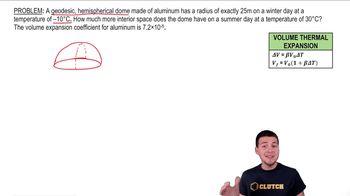
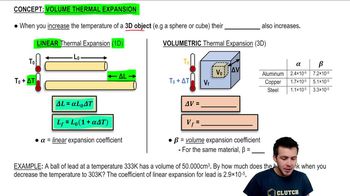
What is the relationship between the volumetric expansion coefficient beta and the linear expansion coefficient alpha for the same material?
The volumetric expansion coefficient beta is equal to three times the linear expansion coefficient alpha. This is because expansion occurs in all three dimensions for volumetric expansion.
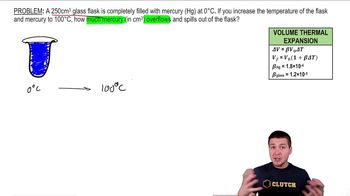
How do you calculate the final volume of an object after a temperature change using the volumetric expansion coefficient?
The final volume is calculated as v_final = v_initial × (1 + beta × delta_t). Here, beta is the volumetric expansion coefficient and delta_t is the change in temperature.
If a lead ball's temperature decreases from 333 K to 303 K, what is the sign of delta T and what does it indicate about the volume change?
Delta T is negative, specifically -30 K, indicating a decrease in temperature. This results in a negative delta v, meaning the volume decreases.
Why can you keep the initial volume in centimeters cubed when calculating the change in volume using the thermal expansion formula?
You can keep the initial volume in centimeters cubed because the units will be consistent throughout the calculation. The resulting change in volume will also be in centimeters cubed.