How does increasing the length of the lever arm affect the force needed to turn a wrench, assuming the required torque remains the same?
If the required torque remains the same, increasing the length of the lever arm decreases the force needed to turn the wrench. This is because torque is the product of force and lever arm length (torque = force × radius), so a longer lever arm means less force is needed to achieve the same torque.
What is one effective way to increase the amount of torque produced by a wind turbine?
One effective way to increase the torque produced by a wind turbine is to increase the length of the blades (the lever arm). Since torque is equal to the force applied times the distance from the axis of rotation (torque = force × radius), longer blades increase the radius and therefore the torque for a given force from the wind.
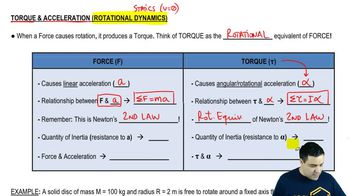
What is the relationship between torque and angular acceleration in rotational dynamics?
In rotational dynamics, the net torque acting on an object is equal to the moment of inertia times the angular acceleration (sum of torques = I × alpha). This is the rotational analog of Newton's second law for linear motion.
What is the rotational equivalent of Newton's second law in linear dynamics?
The rotational equivalent is the equation sum of all torques equals moment of inertia times angular acceleration (Στ = Iα). This describes how torque causes angular acceleration, analogous to how force causes linear acceleration.
In the context of rotational dynamics, what does the moment of inertia represent?
The moment of inertia represents an object's resistance to angular acceleration. It is analogous to mass in linear dynamics, which resists linear acceleration.
How do you calculate the torque produced by a force applied tangentially at the edge of a rotating disc?
The torque is calculated as the force times the radius times the sine of the angle between the force and the radius vector (τ = F × r × sinθ). For a tangential force at the edge, the angle is 90 degrees, so sinθ is 1.
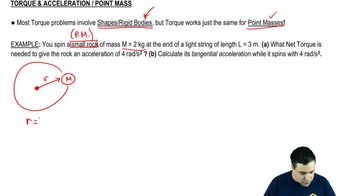
What is the formula for the moment of inertia of a point mass rotating at a distance r from the axis?
The moment of inertia for a point mass is given by I = m × r². Here, m is the mass and r is the distance from the axis of rotation.
How is tangential acceleration related to angular acceleration in rotational motion?
Tangential acceleration (a_tan) is equal to the radius times the angular acceleration (a_tan = r × α). This shows how a change in angular velocity translates to linear acceleration at a point on the rotating object.
What is the unit of torque in the SI system?
The unit of torque in the SI system is the newton-meter (N·m). This unit reflects the product of force and distance from the axis of rotation.
In a frictionless system, what happens to the direction of angular acceleration if the applied torque is clockwise?
If the applied torque is clockwise, the angular acceleration will be negative by convention. This is because clockwise torques are typically assigned a negative sign in rotational dynamics.