Skip to main content
Physics with Calculus
My Course
Learn
Exam Prep
AI Tutor
Study Guides
Textbook Solutions
Flashcards
Explore
Try the app
My Course
Learn
Exam Prep
AI Tutor
Study Guides
Textbook Solutions
Flashcards
Explore
Try the app
Back
Torque & Equilibrium definitions
You can tap to flip the card.
Equilibrium
You can tap to flip the card.
👆
Equilibrium
A state where net force and net torque on an object are zero, resulting in no acceleration or rotational motion.
Track progress
Control buttons has been changed to "navigation" mode.
1/15
Related flashcards
Related practice
Recommended videos
Torque & Equilibrium quiz
Torque & Equilibrium
10 Terms
Torque & Equilibrium quiz #1
Torque & Equilibrium
10 Terms
Torque & Equilibrium
15. Rotational Equilibrium
7 problems
Topic
Patrick
Review: Center of Mass
15. Rotational Equilibrium
5 problems
Topic
15. Rotational Equilibrium - Part 1 of 2
4 topics
9 problems
Chapter
Patrick
15. Rotational Equilibrium - Part 2 of 2
4 topics
12 problems
Chapter
Patrick
Guided course
02:33
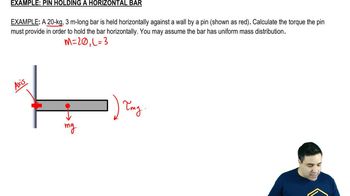
Pin holding a horizontal bar
4820
views
66
rank
5
comments
Guided course
06:05
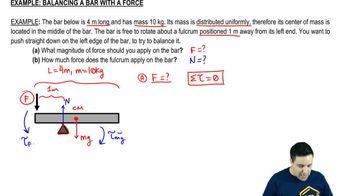
Balancing a bar with a force
6506
views
57
rank
3
comments
Guided course
10:13
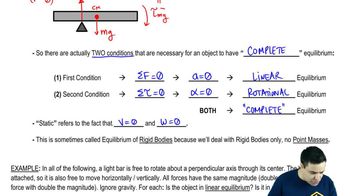
Torque & Equilibrium
9222
views
91
rank
3
comments
Terms in this set (15)
Hide definitions
Equilibrium
A state where net force and net torque on an object are zero, resulting in no acceleration or rotational motion.
Linear Equilibrium
Occurs when the sum of all forces on an object is zero, leading to no linear acceleration.
Rotational Equilibrium
Achieved when the sum of all torques on an object is zero, preventing angular acceleration.
Static Equilibrium
A condition where both linear and rotational equilibrium are present, with no linear or angular velocity.
Torque
A measure of the force causing an object to rotate, calculated as force times distance times sine of the angle.
Axis of Rotation
The line around which an object rotates, crucial in determining the effect of torques.
Center of Mass
The point in an object where its mass is evenly distributed and where weight force acts.
Fulcrum
The pivot point around which a lever or bar rotates, often providing a normal force.
Normal Force
The force exerted by a surface to support the weight of an object resting on it, acting perpendicular to the surface.
Net Force
The vector sum of all forces acting on an object, determining its linear acceleration.
Net Torque
The sum of all torques acting on an object, determining its angular acceleration.
Angular Velocity
The rate of change of an object's angular position, zero in static equilibrium.
Rigid Body
An object with a fixed shape that does not deform under force, often used in equilibrium analysis.
Counterclockwise Torque
A positive torque direction, typically opposing clockwise torque in equilibrium scenarios.
Clockwise Torque
A negative torque direction, often balanced by counterclockwise torque in equilibrium.
 BackBack
 02:33
02:33