Torque with Kinematic Equations quiz #1 Flashcards

Torque with Kinematic Equations quiz #1
Control buttons has been changed to "navigation" mode.
1/10
  • Which factor does the torque on an object not depend on?
    Torque does not depend on the mass of the object alone; it depends on the force applied, the distance from the axis of rotation (lever arm), and the angle at which the force is applied.
  • How do you calculate the gravitational torque about a given point for an object?
    The gravitational torque about a point is calculated as the product of the object's weight (mg) and the perpendicular distance from the point to the line of action of the weight: torque = r × F, where r is the lever arm and F is the gravitational force.
  • How do you determine the torque that a pin must exert to keep a rod from rotating?
    To keep a rod from rotating, the pin must exert a torque equal in magnitude and opposite in direction to the sum of all other torques acting on the rod, ensuring rotational equilibrium (net torque = 0).
  • How do you find the magnitude of the torque on a pole due to an applied force?
    The magnitude of the torque on a pole is given by torque = r × F × sin(θ), where r is the distance from the axis of rotation to the point of force application, F is the magnitude of the force, and θ is the angle between r and F.
  • At what angle is it most efficient to pull on a door to produce the maximum torque?
    It is most efficient to pull on a door at an angle of 90 degrees (perpendicular) to the door, as this maximizes the torque produced for a given force.
  • How is the strength of the force or torque on a compass needle indicated?
    The strength of the force or torque on a compass needle is indicated by the magnitude of the torque, which depends on the force applied and the lever arm (distance from the axis of rotation).
  • What is the term used to describe a twisting force?
    The term used to describe a twisting force is 'torque.'
  • How do you compare the magnitudes of several torques about a hinge?
    To compare the magnitudes of several torques about a hinge, calculate each torque using torque = r × F × sin(θ) for each force, then rank them from largest to smallest based on their calculated values.
  • How do you determine the moment of a force about a point O?
    The moment of a force about point O is calculated as the product of the force and the perpendicular distance from point O to the line of action of the force: moment = r × F × sin(θ).
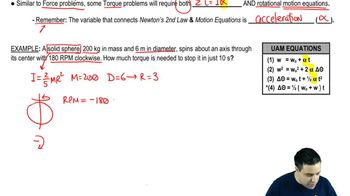
  • Why is the angular acceleration (alpha) positive when stopping a sphere rotating clockwise with a negative angular velocity?
    The angular acceleration is positive because it must act in the opposite direction to the negative (clockwise) angular velocity to bring the sphere to rest. This means the acceleration is counterclockwise, which is defined as positive in this context.