Types of Acceleration in Rotation definitions Flashcards

Types of Acceleration in Rotation definitions
Control buttons has been changed to "navigation" mode.
1/15
  • Centripetal Acceleration
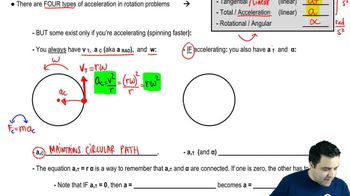
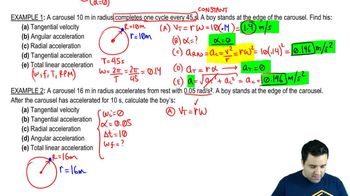
    Responsible for maintaining an object's circular path, pointing towards the center of rotation.
  • Tangential Acceleration
    Occurs when an object speeds up or slows down in rotational motion, zero if speed is constant.
  • Total Acceleration
    Vector sum of tangential and centripetal accelerations, calculated using the Pythagorean theorem.
  • Angular Acceleration
    Rate of change of angular velocity, measured in radians per second squared.
  • Tangential Velocity
    Linear speed of a point on a rotating object, calculated as radius times angular velocity.
  • Centripetal Force
    Force that pulls an object towards the center of its circular path, causing centripetal acceleration.
  • Pythagorean Theorem
    Used to calculate total acceleration as the square root of the sum of squared components.
  • Radians
    Unit of angular measurement used in angular acceleration, equivalent to the angle subtended by an arc.
  • Vector Composition
    Method of combining vectors, such as tangential and centripetal accelerations, to find total acceleration.
  • Rotational Motion
    Movement of an object around a central axis, involving angular velocity and acceleration.
  • Linear Acceleration
    Another term for tangential acceleration, measured in meters per second squared.
  • Angular Velocity
    Rate of change of angular position of a rotating object, often denoted by omega.
  • Period
    Time taken for one complete cycle of rotation, used to calculate angular velocity.
  • Radius
    Distance from the center of a circle to any point on its circumference, crucial in calculating tangential velocity.
  • Constant Velocity
    Condition where angular acceleration is zero, indicating no change in rotational speed.