Types of Collisions definitions Flashcards
Types of Collisions definitions
You can tap to flip the card.
Control buttons has been changed to "navigation" mode.
1/11
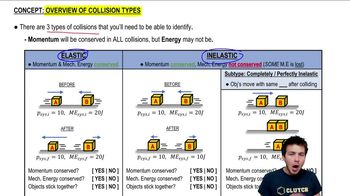
Elastic collisionA type of collision where both momentum and mechanical energy are conserved, with no energy loss.Inelastic collisionA collision where momentum is conserved but mechanical energy is not, resulting in energy loss.Perfectly inelastic collisionA collision where objects stick together post-impact, conserving momentum but not mechanical energy.MomentumA conserved quantity in all collisions, representing the product of an object's mass and velocity.Mechanical energyThe sum of potential and kinetic energy in a system, conserved only in elastic collisions.Energy conservationA principle stating that energy remains constant in an isolated system, applicable in elastic collisions.Energy lossThe reduction of mechanical energy in a system, characteristic of inelastic collisions.VelocityThe speed and direction of an object's motion, crucial in determining post-collision movement.CollisionAn event where two or more bodies exert forces on each other for a short duration.SystemA set of interacting or interdependent components forming an integrated whole, especially in physics.SpectrumA range used to describe the degree of elasticity in collisions, from perfectly elastic to perfectly inelastic.