What happens when two objects collide in terms of momentum and energy?
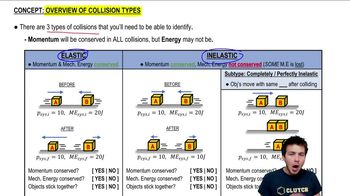
When two objects collide, their total momentum is always conserved. Depending on the type of collision, mechanical energy may or may not be conserved.
What are the forces like during a collision between two objects?
During a collision, the forces between the two objects are equal in magnitude and opposite in direction, as described by Newton's third law.
What characterizes an inelastic collision?
An inelastic collision is characterized by the conservation of momentum but not mechanical energy; some mechanical energy is lost, and the objects do not stick together.
What characterizes an elastic collision?
An elastic collision is characterized by the conservation of both momentum and mechanical energy, with no energy lost and the objects not sticking together.
How do you determine the speed of two objects that stick together after a perfectly inelastic collision?
The speed of the combined system after a perfectly inelastic collision is found by conserving momentum: (m1*v1 + m2*v2) / (m1 + m2), where m1 and m2 are the masses and v1 and v2 are their velocities before the collision.
What is the difference between elastic and inelastic collisions?
Elastic collisions conserve both momentum and mechanical energy, while inelastic collisions conserve momentum but not mechanical energy.
How do elastic and inelastic collisions differ in terms of energy conservation?
Elastic collisions conserve both momentum and mechanical energy, whereas inelastic collisions conserve only momentum and lose some mechanical energy.
What is the main distinction between elastic and inelastic collisions?
The main distinction is that elastic collisions conserve both momentum and mechanical energy, while inelastic collisions conserve only momentum.
How can you describe a perfectly inelastic collision?
A perfectly inelastic collision is one in which the colliding objects stick together and move as a single unit after the collision, conserving momentum but not mechanical energy.
What happens in a collision that is not perfectly elastic?
In a collision that is not perfectly elastic, some mechanical energy is lost, but momentum is still conserved.
What determines whether a collision is elastic or inelastic?
A collision is elastic if both momentum and mechanical energy are conserved; it is inelastic if only momentum is conserved and some mechanical energy is lost.
How do you distinguish between elastic and inelastic collisions?
Elastic collisions conserve both momentum and mechanical energy, while inelastic collisions conserve only momentum and lose some mechanical energy.
Is momentum conserved in both elastic and inelastic collisions?
Yes, momentum is conserved in both elastic and inelastic collisions.
What happens when two objects collide and stick together?
When two objects collide and stick together, it is a perfectly inelastic collision, and they move as a single unit after the collision.
What are the effects of collision forces when objects with different masses collide?
When objects with different masses collide, they exert equal and opposite forces on each other during the collision, regardless of their masses.
If two packages stick together after colliding, how do you find their common speed?
Their common speed is found by conserving momentum: (m1*v1 + m2*v2) / (m1 + m2).
What happens to energy during a collision between objects?
During a collision, total momentum is conserved, but mechanical energy may be lost as heat, sound, or deformation, especially in inelastic collisions.
Which quantities are conserved during an inelastic collision?
Momentum is conserved during an inelastic collision, but mechanical energy is not.
What is a frontal collision in the context of physics?
A frontal collision refers to two objects colliding head-on, and the analysis involves conservation of momentum and, depending on the type, possibly mechanical energy.
What is true of most real-world collisions?
Most real-world collisions are inelastic, meaning they conserve momentum but lose some mechanical energy.
What happens if a collision is perfectly elastic?
If a collision is perfectly elastic, both momentum and mechanical energy are conserved, and the objects do not stick together.
What two factors most affect the amount of damage in a collision?
The amount of damage in a collision is most affected by the relative speed of the objects and their masses.
What is an example of an event that is not a collision?
An event where objects do not interact or exert forces on each other is not considered a collision.
When a small car and a large truck have a head-on collision, what is true about the forces they exert on each other?
They exert equal and opposite forces on each other during the collision, regardless of their masses.
In a collision between two objects of unequal mass, how do the forces compare?
The forces are equal in magnitude and opposite in direction for both objects, as per Newton's third law.
What type of collision could potentially be avoided by increasing speed?
Increasing speed may help avoid a collision if it allows an object to clear the path before another object arrives, but this is not a guarantee and depends on the specific scenario.
How many distinct collisions occur when a vehicle hits a solid object?
Typically, there are three collisions: the vehicle with the object, the occupant with the vehicle interior, and the occupant's internal organs with their body.
How many collisions are involved in a typical crash?
A typical crash involves three collisions: vehicle with object, occupant with vehicle, and internal organs with occupant's body.
What was the significance of collisions of dust in the context of physics?
Collisions of dust particles are significant in physics as they can lead to the aggregation of matter, such as in the formation of planets.
Why are incidents involving multiple types of collisions particularly serious?
Incidents involving multiple types of collisions are serious because each collision can cause additional injury or damage, compounding the effects.
When a large truck collides with a small car, what must be true about the forces during the collision?
The forces exerted by the truck on the car and by the car on the truck are equal in magnitude and opposite in direction.
How many collisions typically occur in a vehicle impact?
Three collisions typically occur: vehicle with object, occupant with vehicle, and internal organs with occupant's body.
Is momentum conserved in both elastic and inelastic collisions?
Yes, momentum is conserved in both elastic and inelastic collisions.
If you double your speed, how does the force in a collision change?
Doubling your speed increases the force in a collision by a factor of four, since kinetic energy depends on the square of speed.
What is analyzed in a frontal collision in physics?
In a frontal collision, conservation of momentum is always applied, and conservation of mechanical energy is considered if the collision is elastic.
What is the primary concern in a frontal collision?
The primary concern in a frontal collision is the transfer of momentum and the potential loss of mechanical energy, which can result in damage or injury.
What is a key characteristic of a frontal collision?
A key characteristic of a frontal collision is that the objects move directly toward each other and collide head-on.
After a collision, what is the first thing you should check for in terms of physics analysis?
The first thing to check is whether momentum is conserved and, if relevant, whether mechanical energy is conserved.
What are the four main factors contributing to the majority of collisions?
The four main factors are speed, mass, direction of motion, and the nature of the collision (elastic or inelastic).
Why do most collisions on city streets occur at intersections?
Most collisions on city streets occur at intersections due to the crossing of multiple traffic flows and increased potential for conflicting movements.