Types Of Forces & Free Body Diagrams definitions Flashcards
Types Of Forces & Free Body Diagrams definitions
1 student found this helpful You can tap to flip the card.
Control buttons has been changed to "navigation" mode.
1/15
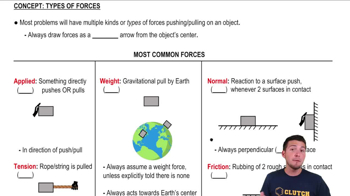
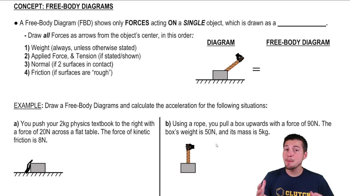
Applied ForceA direct push or pull on an object, represented by an arrow from the object's center in the direction of the force.TensionThe force transmitted through a rope or cable when pulled, depicted as an arrow from the object's center in the direction of the pull.Weight ForceThe force due to gravity, always acting towards the center of the Earth, represented by a downward arrow from the object's center.Normal ForceA reaction force arising from contact between surfaces, always perpendicular to the surface.Friction ForceA force opposing the direction of motion, occurring between rough surfaces in contact.Free Body DiagramA visual tool showing all forces acting on an object as arrows emanating from a central point.Newton's Second LawA principle stating that acceleration is produced when a force acts on a mass (F=ma).Net ForceThe overall force acting on an object, determined by vectorially adding all individual forces.AccelerationThe rate of change of velocity of an object, calculated using the net force and mass.MagnitudeThe size or amount of a force, often represented by the length of an arrow in diagrams.DirectionThe line or path along which something moves, lies, or points, crucial in force representation.AxisA reference line used in diagrams to determine the direction of forces and motion.Contact ForceA force that acts at the point of contact between two objects, such as normal and friction forces.GravityA natural phenomenon by which all things with mass are brought toward one another, like objects toward Earth.SurfaceThe outermost layer of an object, where contact forces like normal and friction occur.