Pearson+ LogoPearson+ Logo
Back

Types Of Forces & Free Body Diagrams quiz #3

Control buttons has been changed to "navigation" mode.
1/15
  • What is a net force?

    Net force is the overall force acting on an object after all the individual forces are combined.
  • What is a force diagram (free body diagram)?

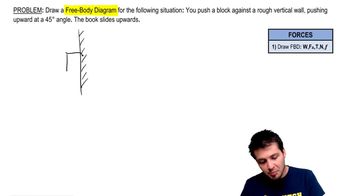
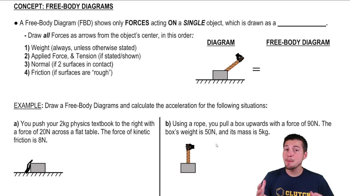
    A force diagram, or free body diagram, is a simple diagram that shows all the forces acting on a single object as arrows emanating from a central point.
  • What is a non-example of a force?

    Temperature is a non-example of a force, as it does not involve a push or pull on an object.
  • What is an example of an unbalanced force?

    An example of an unbalanced force is pushing a box so that it starts to move across the floor.
  • Which of the following is not a force?

    Mass is not a force; it is a measure of the amount of matter in an object.
  • What two aspects of a force do scientists measure?

    Scientists measure the magnitude (size) and direction of a force.
  • Which is a good example of a contact force?

    Friction between a box and the floor is a good example of a contact force.
  • Which could be an example of an unbalanced force?

    A person pulling a sled so that it accelerates is an example of an unbalanced force.
  • Which could be an example of a balanced force?

    A book resting on a table with gravity pulling it down and the normal force pushing it up is an example of balanced forces.
  • Which best describes a force?

    A force is a push or pull acting on an object.
  • How does friction affect motion?

    Friction opposes the motion of objects, causing them to slow down or stop.
  • How do you calculate net force?

    To calculate net force, add together all the forces acting on an object, taking their directions into account (vector sum).
  • How do you find the net force acting on an object?

    Find the net force by summing all the individual forces acting on the object, considering their directions.
  • What is friction?

    Friction is a force that opposes the relative motion of two surfaces in contact.
  • What are the five most common types of forces discussed in physics problems?

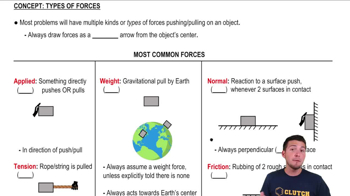
    The five most common types of forces are applied force, tension, weight (gravity), normal force, and friction.