Newton's Third Law & Action-Reaction Pairs definitions Flashcards

Newton's Third Law & Action-Reaction Pairs definitions
Control buttons has been changed to "navigation" mode.
1/15
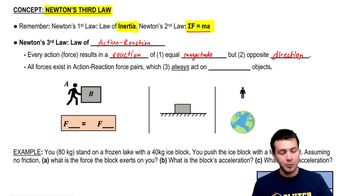
  • Newton's Third Law
    States that for every action force, there is an equal and opposite reaction force.
  • Action-Reaction Pair
    A set of forces where one force is the action and the other is the equal and opposite reaction.
  • Magnitude
    The size or strength of a force, which remains equal in action-reaction pairs.
  • Direction
    The line along which a force acts, opposite in action-reaction pairs.
  • Normal Force
    A force exerted by a surface in response to an object resting on it, part of an action-reaction pair.
  • Weight Force
    The gravitational force exerted by the Earth on an object, part of an action-reaction pair.
  • Free Body Diagram
    A graphical representation used to visualize the forces acting on an object.
  • Acceleration
    The rate of change of velocity of an object, calculated using F=ma.
  • Equilibrium
    A state where all forces are balanced, resulting in no net force and no acceleration.
  • Mass
    A measure of the amount of matter in an object, affecting its acceleration under force.
  • Frozen Lake
    A surface with negligible friction, used in physics problems to simplify calculations.
  • Force
    An interaction that changes the motion of an object, measured in newtons.
  • Surface Push
    A force applied perpendicular to a surface, often resulting in a normal force.
  • Inertia
    The tendency of an object to resist changes in its state of motion.
  • F=ma
    The equation representing Newton's second law, relating force, mass, and acceleration.