Newton's Third Law & Action-Reaction Pairs quiz #1 Flashcards

Newton's Third Law & Action-Reaction Pairs quiz #1
Control buttons has been changed to "navigation" mode.
1/39
  • Which best describes two counteracting forces on an object according to Newton's third law?
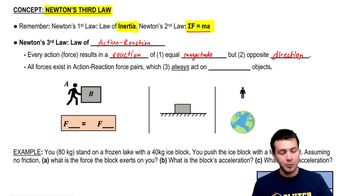
    Two counteracting forces are equal in magnitude and opposite in direction, and they act on different objects as an action-reaction pair.
  • How does the force exerted by a rifle on a bullet compare with the force exerted by the bullet on the rifle when fired?
    The force exerted by the rifle on the bullet is equal in magnitude and opposite in direction to the force exerted by the bullet on the rifle.
  • Which of the following are examples of action-reaction force pairs according to Newton's third law?
    Any pair of forces where one object exerts a force on a second object and the second object exerts an equal and opposite force on the first, such as a person pushing a block and the block pushing back on the person.
  • Do the downward force exerted by an object and the upward force exerted by the surface it rests on constitute a Newton's third law pair?
    Yes, the downward force (weight) exerted by the object on the surface and the upward normal force exerted by the surface on the object are an action-reaction pair.
  • Why does a rocket move forward when its engines expel gases backward?
    A rocket moves forward because the expulsion of gases backward exerts an equal and opposite reaction force on the rocket, propelling it forward according to Newton's third law.
  • What is the direction of the force exerted by the upper leg on the lower leg at the knee joint?
    The force exerted by the upper leg on the lower leg at the knee joint is equal in magnitude and opposite in direction to the force exerted by the lower leg on the upper leg.
  • According to Newton's third law of motion, what happens when one object exerts a force on another?
    When one object exerts a force on another, the second object exerts an equal and opposite force on the first object.
  • A desk weighing 200 N rests on the floor. How much force does the floor apply to the desk?
    The floor applies an upward force of 200 N to the desk, equal in magnitude and opposite in direction to the desk's weight.
  • The Earth's gravity is pulling on you. Are you also pulling on the Earth?
    Yes, you pull on the Earth with a force equal in magnitude and opposite in direction to the force the Earth exerts on you.
  • According to Newton's third law, how are action and reaction forces related?
    Action and reaction forces are equal in magnitude, opposite in direction, and act on different objects.
  • When a cannon fires a cannonball, which force is the reaction force according to Newton's third law?
    The reaction force is the force exerted by the cannonball on the cannon, which is equal in magnitude and opposite in direction to the force the cannon exerts on the cannonball.
  • Which of Newton's three laws focuses on interactions between objects?
    Newton's third law focuses on interactions between objects, stating that every action has an equal and opposite reaction.
  • How much force does a 4.0 kg block exert on a 5.0 kg block if the 5.0 kg block exerts a force on the 4.0 kg block?
    The 4.0 kg block exerts a force equal in magnitude and opposite in direction to the force the 5.0 kg block exerts on it.
  • The action force on an object is equal to what?
    The action force on an object is equal in magnitude and opposite in direction to the reaction force exerted by the other object.
  • Why does a cannon recoil when it fires a cannonball?
    A cannon recoils because the force exerted on the cannonball by the cannon is matched by an equal and opposite force exerted on the cannon by the cannonball.
  • When a hammer strikes a nail and drives it into a surface, what effect does the nail have on the hammer?
    The nail exerts an equal and opposite force on the hammer as the hammer exerts on the nail.
  • When a ball bounces on the ground, how do the ball and the ground act on each other?
    The ball exerts a force on the ground, and the ground exerts an equal and opposite force on the ball.
  • What occurs when a swimmer pushes through the water to swim forward?
    When a swimmer pushes water backward, the water pushes the swimmer forward with an equal and opposite force.
  • How can Newton's law of action-reaction be applied to explain the movement of a rocket?
    Newton's third law explains that as a rocket expels gases backward, the gases exert an equal and opposite force on the rocket, propelling it forward.
  • What is the best example of Newton's third law of motion?
    An example is when you push on a wall, the wall pushes back on you with an equal and opposite force.
  • What is the magnitude of the force with which one block acts on another block in contact?
    The magnitude of the force with which one block acts on another is equal to the magnitude of the force the second block exerts on the first, according to Newton's third law.
  • What allows a rocket to move in space where there is no air?
    A rocket moves in space because expelling gases backward creates an equal and opposite reaction force that propels the rocket forward.
  • When a mosquito collides head-on with a truck, what is true about the forces during the collision?
    The mosquito and the truck exert equal and opposite forces on each other during the collision.
  • If a person sits in a chair reading a book, which force is equal to the force the person exerts on the Earth?
    The force the Earth exerts upward on the person is equal in magnitude and opposite in direction to the force the person exerts downward on the Earth.
  • What are five examples of Newton's third law in everyday life?
    Examples include: (1) walking (foot pushes ground, ground pushes foot), (2) swimming (hand pushes water, water pushes hand), (3) jumping (legs push ground, ground pushes legs), (4) firing a gun (gun pushes bullet, bullet pushes gun), (5) sitting on a chair (body pushes chair, chair pushes body).
  • The force created when the court pushes a basketball player upwards is equal to which force?
    It is equal in magnitude and opposite in direction to the force the player exerts downward on the court.
  • Which best describes the forces identified by Newton's third law of motion?
    They are equal in magnitude, opposite in direction, and act on different objects.
  • How does a simulation of two objects pushing against each other demonstrate Newton's third law of motion?
    The simulation shows that when one object exerts a force on another, the second object exerts an equal and opposite force on the first.
  • What will happen to a boat when a person steps off of it toward the left?
    The boat will move to the right, as the force exerted by the person stepping left is matched by an equal and opposite force on the boat.
  • How does air push an airboat forward?
    The airboat's propeller pushes air backward, and the air pushes the boat forward with an equal and opposite force.
  • If you swing a bat and hit a heavy box with a force of 1500 N, what is the force the box exerts on the bat?
    The box exerts a force of 1500 N on the bat in the opposite direction.
  • A rifle recoils while firing a bullet. Why is the speed of the rifle's recoil small compared to the bullet's speed?
    The rifle's recoil speed is small because its mass is much greater than the bullet's, even though the forces are equal and opposite.
  • Does every force have one and only one third law pair force?
    Yes, every force has one and only one third law pair force that is equal in magnitude and opposite in direction.
  • What is one consequence of Newton's third law of motion?
    One consequence is that forces always come in pairs, so when one object exerts a force on another, it experiences an equal and opposite force.
  • According to Newton's third law, what is the force on the smaller moon due to the larger Earth compared to the force on the Earth due to the moon?
    The force the Earth exerts on the moon is equal in magnitude and opposite in direction to the force the moon exerts on the Earth.
  • Newton's third law of motion says that for every action there is a(n) _____ and opposite reaction.
    For every action there is an equal and opposite reaction.
  • If two boats are operating near each other, which boat must maintain its course and speed according to Newton's third law?
    Newton's third law does not determine which boat must maintain its course and speed; it only states that forces between the boats are equal in magnitude and opposite in direction.
  • What is the magnitude of the force that box A exerts on box B when they are in contact?
    The magnitude of the force that box A exerts on box B is equal to the magnitude of the force that box B exerts on box A, according to Newton's third law.
  • How many action-reaction pairs of forces exist between a car and the road surface?
    There is one action-reaction pair for each point of contact where the car exerts a force on the road and the road exerts an equal and opposite force on the car.