Pearson+ LogoPearson+ Logo

Newton's Third Law & Action-Reaction Pairs quiz #2 Flashcards

Back
Newton's Third Law & Action-Reaction Pairs quiz #2
Control buttons has been changed to "navigation" mode.
1/10
  • What does Newton's third law of motion state?

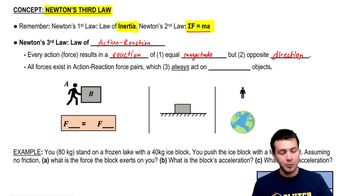
    Newton's third law states that for every action force, there is an equal and opposite reaction force; when one object exerts a force on another, the second object exerts a force of equal magnitude in the opposite direction.
  • By what other name is Newton's third law of motion known?

    Newton's third law of motion is also known as the law of action-reaction.
  • Which sentence best states Newton’s third law of motion?

    For every action force, there is an equal and opposite reaction force.
  • Which sentence describes Newton's third law of motion?

    When one object exerts a force on another, the second object exerts a force of equal magnitude in the opposite direction; these forces always act on different objects.
  • Why do action-reaction force pairs not cancel each other out on a single object?

    Action-reaction force pairs act on different objects, not the same object. Therefore, they do not cancel each other out and can result in motion.
  • What must you do when analyzing forces on multiple interacting objects according to Newton's third law?

    You must draw separate free body diagrams for each object involved. This helps identify all forces acting on each object individually.
  • How does the mass of two objects affect their accelerations when equal and opposite forces are applied between them?

    The object with smaller mass will experience a greater acceleration. This is because acceleration is inversely proportional to mass for a given force.
  • In the example of a person pushing a block on ice, what is the direction of the reaction force acting on the person?

    The reaction force acts in the direction opposite to the force the person applies to the block. If the person pushes right, the reaction force on the person is to the left.
  • Can action-reaction pairs exist between objects that are not in direct contact, and if so, give an example?

    Yes, action-reaction pairs can exist without direct contact, such as gravitational forces between the Earth and a person. The Earth pulls the person down, and the person pulls the Earth up with equal magnitude.
  • What is the mathematical relationship between the force of object A on object B and the force of object B on object A?

    The force of A on B is equal in magnitude and opposite in direction to the force of B on A. This is written as F_AB = -F_BA.