How do you express a vector, such as vector b, using unit vectors in the Cartesian coordinate system?
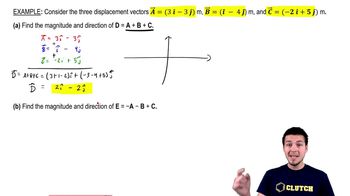
To express a vector b using unit vectors in the Cartesian coordinate system, write it as the sum of its components along the x, y, and z axes multiplied by the corresponding unit vectors: b = b_x i + b_y j + b_z k, where b_x, b_y, and b_z are the scalar components of b in the x, y, and z directions, and i, j, and k are the unit vectors in those directions.
What is the magnitude of a unit vector by definition?
A unit vector always has a magnitude of one. This property allows it to indicate direction only, not length.
In which directions do the unit vectors i, j, and k point in the Cartesian coordinate system?
The unit vector i points in the positive x direction, j in the positive y direction, and k in the positive z direction. These directions correspond to the axes of the Cartesian system.
How does unit vector notation simplify the process of vector addition?
Unit vector notation allows you to add vectors by simply adding their corresponding i, j, and k components. This eliminates the need for decomposing vectors into magnitudes and angles.
If a vector is written as 3i + 4j, what are its x and y components?
The x component is 3 and the y component is 4. These values represent the number of units in the i and j directions, respectively.
What does a negative coefficient in front of a unit vector indicate about the direction of the vector component?
A negative coefficient means the component points in the negative direction of that axis. For example, -i points in the negative x direction.
How can you graphically interpret the vector 4i + 2j?
You move 4 units in the x direction and 2 units in the y direction from the origin. The resulting point gives the tip of the vector.
What is the resultant vector when adding 4i + 2j and -i + 2j using unit vector notation?
The resultant vector is 3i + 4j. This is found by adding the i components (4 + -1) and the j components (2 + 2).
Why did physicists introduce the i, j, and k notation for vectors?
Physicists introduced this notation to provide a standardized and clear way to represent vector components along each axis. It helps avoid confusion and streamlines vector calculations.
What does the vector 3i + 4j represent in terms of a right triangle?
It represents a right triangle with legs of length 3 and 4 along the x and y axes, respectively. The hypotenuse of this triangle is the vector's magnitude.