Skip to main content
Physics with Calculus
My Course
Learn
Exam Prep
AI Tutor
Study Guides
Textbook Solutions
Flashcards
Explore
Try the app
My Course
Learn
Exam Prep
AI Tutor
Study Guides
Textbook Solutions
Flashcards
Explore
Try the app
Back
Unit Conversions definitions
3 students found this helpful
You can tap to flip the card.
SI system
You can tap to flip the card.
👆
SI system
A standardized system of units used globally in science and industry, ensuring compatibility and consistency in measurements.
Track progress
Control buttons has been changed to "navigation" mode.
1/15
Related flashcards
Related practice
Recommended videos
Unit Conversions quiz
Unit Conversions
10 Terms
Unit Conversions quiz #1
Unit Conversions
10 Terms
Unit Conversions
1. Intro to Physics Units
6 problems
Topic
Patrick
Solving Density Problems
1. Intro to Physics Units
5 problems
Topic
Patrick
1. Intro to Physics Units
6 topics
14 problems
Chapter
Patrick
Guided course
07:46
Unit Conversions
22835
views
522
rank
8
comments
Terms in this set (15)
Hide definitions
SI system
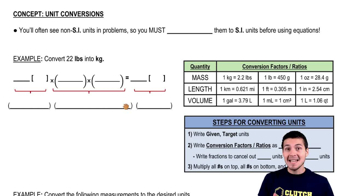
A standardized system of units used globally in science and industry, ensuring compatibility and consistency in measurements.
Non-SI units
Units not part of the International System of Units, often requiring conversion for scientific calculations.
Conversion factor
A ratio expressed as a fraction that relates two different units, used to convert measurements.
Conversion ratio
Another term for conversion factor, emphasizing its expression as a fraction to facilitate unit conversion.
Metric prefixes
Prefixes that denote powers of ten, used to express multiples or fractions of units in the metric system.
Kilogram
The base unit of mass in the SI system, equivalent to 1000 grams.
Pound
A unit of mass in the imperial system, often converted to kilograms in scientific contexts.
Miles per hour
A unit of speed expressing the number of miles traveled in one hour, often converted to meters per second.
Meters per second
The SI unit of speed, representing the distance in meters traveled in one second.
Feet squared
A unit of area in the imperial system, often converted to meters squared in scientific calculations.
Meters squared
The SI unit of area, representing a square with sides of one meter each.
Exponent
A mathematical notation indicating the number of times a unit is multiplied by itself.
Numerator
The top part of a fraction, representing the number of parts considered.
Denominator
The bottom part of a fraction, representing the total number of equal parts.
Canceling units
A method in unit conversion where units in the numerator and denominator are eliminated to simplify calculations.
 BackBack
 07:46
07:46