How do you convert a velocity of 58 meters per second (m/s) to miles per hour (mph)?
To convert 58 m/s to mph, use the following steps: (1) Convert meters to miles using the conversion factor 1 mile = 1609 meters, and (2) convert seconds to hours using 1 hour = 3600 seconds. The formula is: velocity (mph) = 58 m/s × (1 mile / 1609 m) × (3600 s / 1 hour). Multiply these together to get the velocity in mph.
What is the approximate value of 55 miles per hour (mi/h) in kilometers per hour (km/h)?
To convert miles per hour to kilometers per hour, use the conversion factor 1 mile = 1.609 kilometers. Multiply 55 mi/h by 1.609 to get approximately 88.5 km/h, which is close to 90 km/h.
How do you convert 10,000 meters to miles?
To convert 10,000 meters to miles, use the conversion factor 1 mile = 1609 meters. Divide 10,000 meters by 1609 meters/mile: 10,000 m ÷ 1609 m/mile ≈ 6.22 miles.
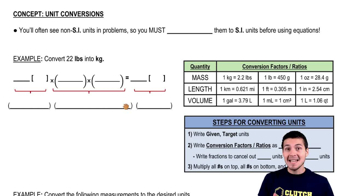
What is the first step you should take when converting a non-SI unit to an SI unit in a physics problem?
You should write down your given value and its units, as well as your target units. This helps you organize the conversion process and identify the necessary conversion factors.
How do you determine the correct orientation of a conversion factor when setting up a unit conversion?
Arrange the conversion factor so that the unit you want to cancel appears on the opposite side (top or bottom) of your starting value. This ensures the unwanted unit cancels out during multiplication.
What should you do if you need to convert a unit with an exponent, such as feet squared to meters squared?
You must apply the conversion factor as many times as the exponent indicates, so for feet squared to meters squared, use the conversion factor twice. This ensures both units in the exponent are properly converted.
How can metric prefixes be used in unit conversions?
Metric prefixes, like kilo-, can be treated as conversion factors (e.g., 1 kilometer = 1,000 meters). They allow you to convert between different scales within the metric system.
What is the relationship between hours, minutes, and seconds that is useful for time unit conversions?
One hour equals 60 minutes, and one minute equals 60 seconds, so one hour equals 3,600 seconds. This relationship is used to convert between hours and seconds.
Why is it important to ensure all units are compatible before plugging values into physics equations?
Physics equations require all units to be in the same system, usually SI, to ensure the calculations are correct. Incompatible units can lead to incorrect results or nonsensical answers.
What is the general process for multiplying and dividing numbers when performing unit conversions?
Multiply all the numbers in the numerators and divide by all the numbers in the denominators after setting up your conversion factors. This gives you the final value in the desired units.