What is the approximate distance between the Earth and the Sun in meters?
The approximate distance between the Earth and the Sun is 1.5 × 10¹¹ meters.
Why are distances in space often quoted in units of light-years?
Distances in space are often quoted in light-years because astronomical distances are extremely large, and a light-year provides a convenient unit based on the distance light travels in one year.
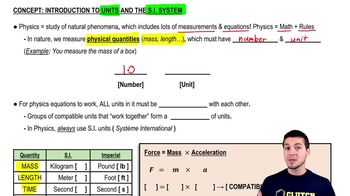
What must all units in a physics equation have in common for the equation to work correctly?
All units must be compatible with each other, meaning they must belong to the same system of units. Mixing units from different systems can lead to incorrect results.
What is the main system of units used in physics and what does its abbreviation stand for?
The main system is the SI system, which stands for 'Système International' in French. It is the standard for scientific measurements.
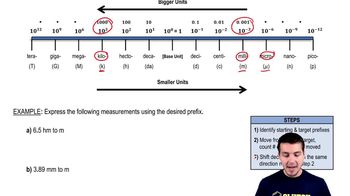
How do metric prefixes like kilo and milli help when expressing measurements?
Metric prefixes represent specific powers of ten, allowing large or small numbers to be written more compactly. This makes calculations and conversions easier.
What is the process for converting a measurement from one metric prefix to another?
First, identify the starting and target prefixes, then count the number of exponent steps between them and shift the decimal place in the same direction. This changes the number to match the new prefix.
When converting from a larger to a smaller metric unit, what happens to the numerical value of the measurement?
The numerical value becomes larger because there are more of the smaller units in the same quantity. This is due to shifting the decimal to the right.
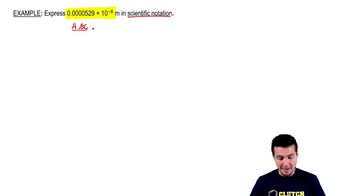
What is the general format for writing a number in scientific notation?
The format is a number between 1 and 10 multiplied by 10 raised to an exponent, written as a.bc × 10^d. This allows for concise representation of very large or small numbers.
How do you determine the exponent when converting a standard number to scientific notation?
Count the number of decimal places you move to get a number between 1 and 10; this count is the exponent. If you move left, the exponent is positive; if right, it is negative.
What does a negative exponent in scientific notation indicate about the size of the number?
A negative exponent means the number is less than one and the decimal point is moved to the left. This results in a smaller value in standard form.
What is the SI unit used to measure the frequency of a wave?
The SI unit for frequency is the hertz (Hz).
In physics, which unit is used to measure frequency?
Frequency is measured in hertz (Hz).
What is the SI unit for acceleration?
The SI unit for acceleration is meters per second squared (m/s²).
What is the SI unit of electric current?
The SI unit of electric current is the ampere (A).
What are the units for acceleration in the SI system?
Acceleration is measured in meters per second squared (m/s²).
Which units are used to measure both velocity and speed in the SI system?
Both velocity and speed are measured in meters per second (m/s) in the SI system.
What units are used to measure velocity in physics?
Velocity is measured in meters per second (m/s).
What is force measured in according to the SI system?
Force is measured in newtons (N) in the SI system.
What is the SI unit for wavelength?
Wavelength is measured in meters (m) in the SI system.
What is the SI unit of force?
The SI unit of force is the newton (N).
What is the unit for force in physics?
Force is measured in newtons (N).
What is frequency measured in?
Frequency is measured in hertz (Hz).
What is the SI unit for wave frequency?
The SI unit for wave frequency is the hertz (Hz).
Which SI base units are combined to describe force?
Force is described by combining kilograms (kg), meters (m), and seconds (s) as: 1 newton (N) = 1 kg·m/s².
 Back
Back
 06:06
06:06